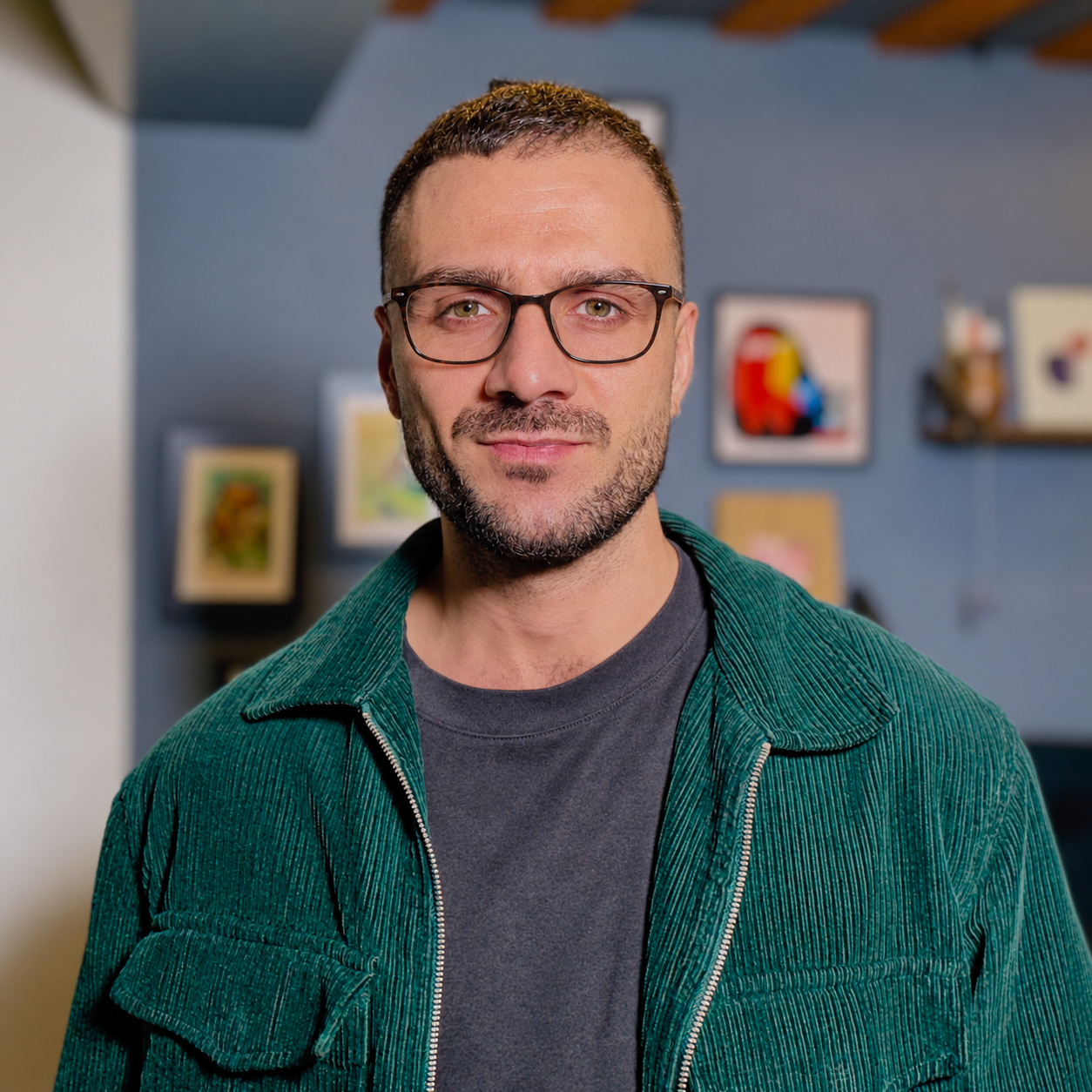
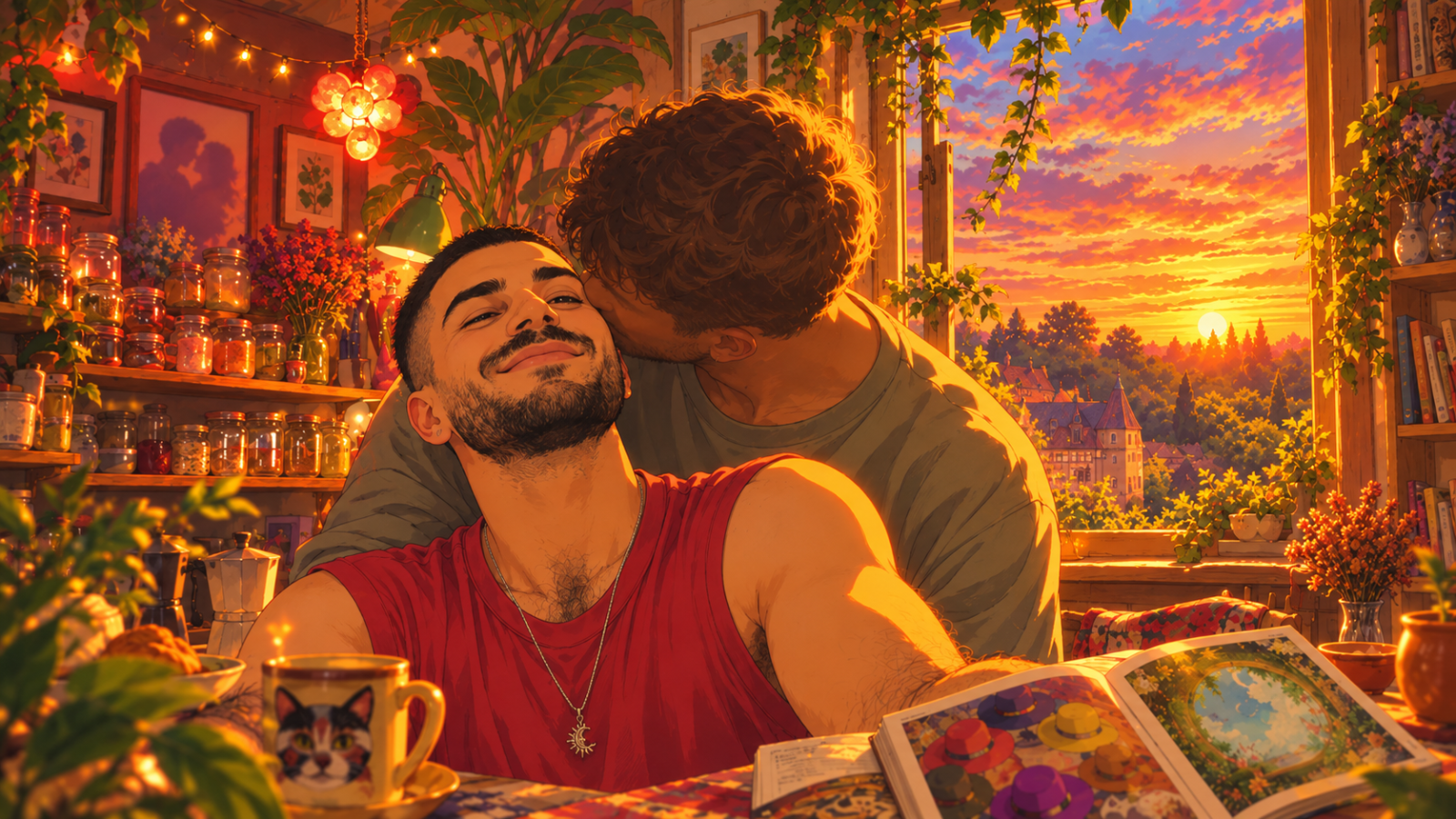
I don’t remember the moment My Sunshine became part of my existence. I remember the first time I saw him, and I remember the disappointment I felt when I learned, in June 2023, that he wasn’t available to me. I remember countless tiny details that, for reasons I still don’t understand, my memory decided to preserve with extraordinary precision. But I cannot point to the day when his place inside me changed, when he stopped being someone I simply hoped I could keep seeing and became someone around whose presence my life itself had begun to take shape. I remember us sitting together once, laughing about everything that had happened since we met, when I said, “My God, what a rollercoaster.” Then I looked at him and felt genuinely amazed. This was the same person I had once seen from a distance and wished could somehow be close to me, and now he was sitting there in front of me. He knew me, and I knew him. He had become Bubu, the light in my eyes. I told him then that my dream had come true, and that somehow it still didn’t feel entirely real. I think that was the moment I finally noticed that I was no longer waiting for love. I had already been living inside it for some time.
Our love was not built mainly from the grand scenes that would look good in a movie. It was built from small things repeated often enough that, together, they became something much larger than themselves. I loved the mornings when he had to leave early for work, when we moved around the kitchen half asleep, one of us making coffee while the other opened the fridge or looked for something to eat, both of us thinking about what the other might need during the day. Sometimes I made him breakfast or packed something for him to eat later, and sometimes he had already thought of something I needed before I had. It wasn’t about dividing roles. It was that particular kind of care that becomes automatic over time, as though each of us had quietly added the other person’s body to the list of things we paid attention to: whether he had eaten, whether he had slept, whether he was tired, whether he needed coffee, a hug, or simply to be left alone for a while. I think love becomes more intimate when it leaves language and enters these small details, the things that usually seem too ordinary to be worth telling anyone about.
Food was one of the most beautiful places where we met each other. I love cooking and baking, and he knew how happy it made me to try something new and then sit across from him waiting for that first bite. I could usually see the exact moment he liked something before he said a word. It was there in his eyes, or in the way he chewed, and I would laugh because somehow I had learned to recognize even that. But he knew me too. He knew what I liked, what made me happy, what I needed after a bad day. Food became an extension of the body between us: something made by one person’s hands entering the other person’s body and giving him pleasure. Maybe that is why the kitchen never felt entirely separate from intimacy to me. There was the smell of food, fingers stealing tastes from a plate, our bodies passing each other in a narrow space, and glances that were saying something completely different while we pretended to be deciding whether dinner needed more salt.
I also loved cutting Bubu’s hair. Very early on, grooming became one of our rituals, and I used to joke that everything about his body was my responsibility. There was a kind of playful possessiveness in that sentence, not the kind that wants to imprison another person, but the feeling that the body of someone you love has become a place you know, adore, and want to take care of. I would make him sit down, put a towel around his shoulders, run my fingers through his hair to decide where to cut, and lean close to his face while shaping his beard. Sometimes he would laugh or move, and I would tell him to sit still. I loved the trust he placed in my hands, just as I loved the many ways he took care of me too. When I think about it now, I think of cats grooming one another. Grooming among them is not simply about cleanliness; it is a language of trust and closeness, as if the body is telling another body, “I allow you to reach places I do not leave exposed to everyone.” The rest of the stories about hair and bodies I will keep for myself. I don’t want writing to turn everything we lived into public property.
Perhaps one of the things I loved most was the private world we slowly created, complete with its own vocabulary. We shared almost everything: what we had learned, what we had watched, what happened during our day, the people who had annoyed us, and the ideas that were still taking shape inside our heads. I loved learning from him and listening when he spoke about something he understood better than I did. I liked that he disagreed with me or corrected me, just as I sometimes did with him. Alongside all of that was our private stupidity, which required absolutely no intellectual value to become precious. Sometimes one look was enough for both of us to realize we were thinking exactly the same thing, and then we would start laughing while everyone around us stared in confusion. “Coconut tree” is one of those things I will never explain. He knows, and I know, and that is enough. There was Cigarettes After Sex, ATY, “I Have Nothing,” and names, places and facial expressions that would mean almost nothing to anyone else but carried entire stories for us. When two people stay close long enough, language itself begins to take their side.
Then there were the more private things: walks, yoga, trips, nights and adventures that I don’t particularly want to see stripped of their context and displayed in front of strangers. Some fantasies, some things that happened in the dungeon, and some moments that needed no deeper meaning whatsoever because they were fun, daring and just crazy enough at the time. I like that those things remain ours. Intimacy, I think, is not only what we dare to reveal. It is also what we choose to protect from other people’s eyes. There is something beautiful about knowing that, in a world that seems determined to turn every experience into a photograph, a Story or a public confession, there are still memories belonging only to us. They remain real even if nobody else ever witnessed them.
Physical intimacy with him was different for me from desire alone. I knew desire before him, but what I had not always known was that another person’s body could make you feel safe and aroused at exactly the same time. I would look into My Sunshine’s eyes and watch them become heavier, sleepier. The colour would rise in his cheeks, his breathing would change, and I could feel the warmth of his body calling something out of mine, as though one body were waking the other. He moved closer when I moved closer. He touched me as I touched him. Something travelled between us, reciprocal and almost impossible to locate, and I could never quite tell who had started it. Sometimes, after a long kiss, I would have to take a deep breath, as though I had just surfaced from underwater. In certain moments, however strange this may sound, I felt as if something of his soul entered me and something of mine entered him, and skin stopped feeling like such a definite border between two people.
Maybe that is why I understand the idea of twin flames, even though I don’t treat it as some cosmic truth. I don’t know whether souls were once whole and then split apart, but I understand the feeling that made human beings invent metaphors like that. Sometimes closeness becomes so intense that the word attraction feels insufficient, as though what is happening is not only one body wanting another but two presences recognizing each other and intensifying whatever exists between them. There are images in Love, Death & Robots of characters moving beyond the boundaries of the body and dissolving into something larger than themselves. That image stayed with me because some of our moments felt like that, at least inside my imagination: a voluntary surrender to something you had no desire to resist. I never wanted to disappear into him, nor did I want him to disappear into me. I simply understood, for a few seconds at a time, how two people could remain entirely themselves and still feel as though they had created something third between them, something that belonged to both.
Perhaps that is also why our conflicts could become intense. I don’t believe fighting is proof of love, and I don’t want to rename chaos “passion” just to make it prettier after the fact. But the person we allow closest to us is also the person who can reach our fear, jealousy, stubbornness and need for safety. For me, the problem was never simply that we disagreed. What mattered was what happened afterwards. I wanted us to understand why something one of us had said had hit such a sensitive place in the other, and I wanted conflict to become knowledge rather than a series of closed doors. We did not always succeed. I made mistakes, and so did he. Sometimes we were frightened, and we acted from fear instead of trust. But I don’t want to polish this love story now that part of it is behind me until one of us becomes a saint and the other becomes the accused. One of the most beautiful things about us, and one of the hardest, was that we were two real people who loved each other and brought into that love our histories, our vulnerabilities, and parts of ourselves neither of us had fully understood yet.
During some of those periods, when we fought or pulled away from each other for a little while, a feeling would sometimes pass through me that perhaps he had gone to see someone else. I never knew that for certain, and I don’t want to transform a feeling into a fact now. What interests me more is that, at the time, I never really believed that some side experience, if it happened, could erase what existed between us. I had enormous faith that we belonged to one another. Perhaps there was some naivety in that, some arrogance, and some trust. I would think about that old saying about letting the bird fly: if it returns, then it chose to return. I dislike the part of that idea that suggests someone becomes ours simply because they came back, but I like the idea of return as a choice. I never wanted a love that survived only because every other door in the world had been locked. I wanted a love that could see the doors and still know which home it wanted to return to.
And that is where my private joke about frogs came from. Let the light in my eyes go kiss a few frogs if he needs to; maybe I will kiss a few myself. Sometimes we need another experience to understand what we had from a different angle, and perhaps we discover something we ourselves would rather not hear. That is what freedom means. We cannot demand freedom and then dictate its outcome. Meanwhile, I don’t want to stand still waiting for somebody else’s journey to end. I have strawberries, food I want to cook, a river where I can sit, and a gym that, fortunately, contains a perfectly adequate number of beautiful men to remind me that my eyes are still functioning very well. I love Bubu, but life does not require me to stop living in order to prove it.
I also don’t want this experience to teach me to love less. I want to learn to slow myself down when I am frightened, to check reality before constructing an entire story in my head, to understand the difference between caring and controlling, and to listen for longer before answering. But I do not want to lose my excitement, my laughter, or the way I notice beautiful things. I do not want to offer the world a quieter, simpler and less complicated version of myself merely so I might become easier to love. I can learn not to interrupt someone when an idea suddenly explodes into my head, but I do not want to cure the enthusiasm that made me interrupt them in the first place. Growth, to me, is not removing the parts that make me who I am. It is learning when one of those qualities becomes harmful and how to use it differently.
Maybe that is why I cannot remember exactly when the soul of my soul became part of me. There was no grand declaration and no single scene I could circle on a calendar. It happened in the food we shared, in the scissors between my fingers, in his hands learning my body as mine learned his, in a joke nobody else understood, in a fight that repaired something once and broke something another time, in a kiss that left me needing air, and in an ordinary morning we did not yet know would one day become a memory. By the time I finally noticed what had happened, he was already there. He was not someone I revolved around, and I was not someone revolving around him. He was simply someone who had walked beside me long enough for some of our footsteps to become difficult to separate.
Perhaps this is what I most want to keep from everything we lived. When love was good, it was neither one person sacrificing everything nor the other playing the hero. It moved back and forth between us: two bodies moving closer, two hands taking care of each other, two minds arguing and learning, and two people saying, in different languages and different ways, sometimes with a plate of food, sometimes with a kiss, and sometimes with a pair of scissors dangerously close to an ear, “I see you. I know you. And I want to come closer.” I don’t know what shape this love will take with time, but I know I do not want to recover from my ability to feel it. I only want to learn how to love with this much intensity without needing to lose myself in order to prove that I love.
Comments
Comments are published after moderation. Your email address will not be shown.