
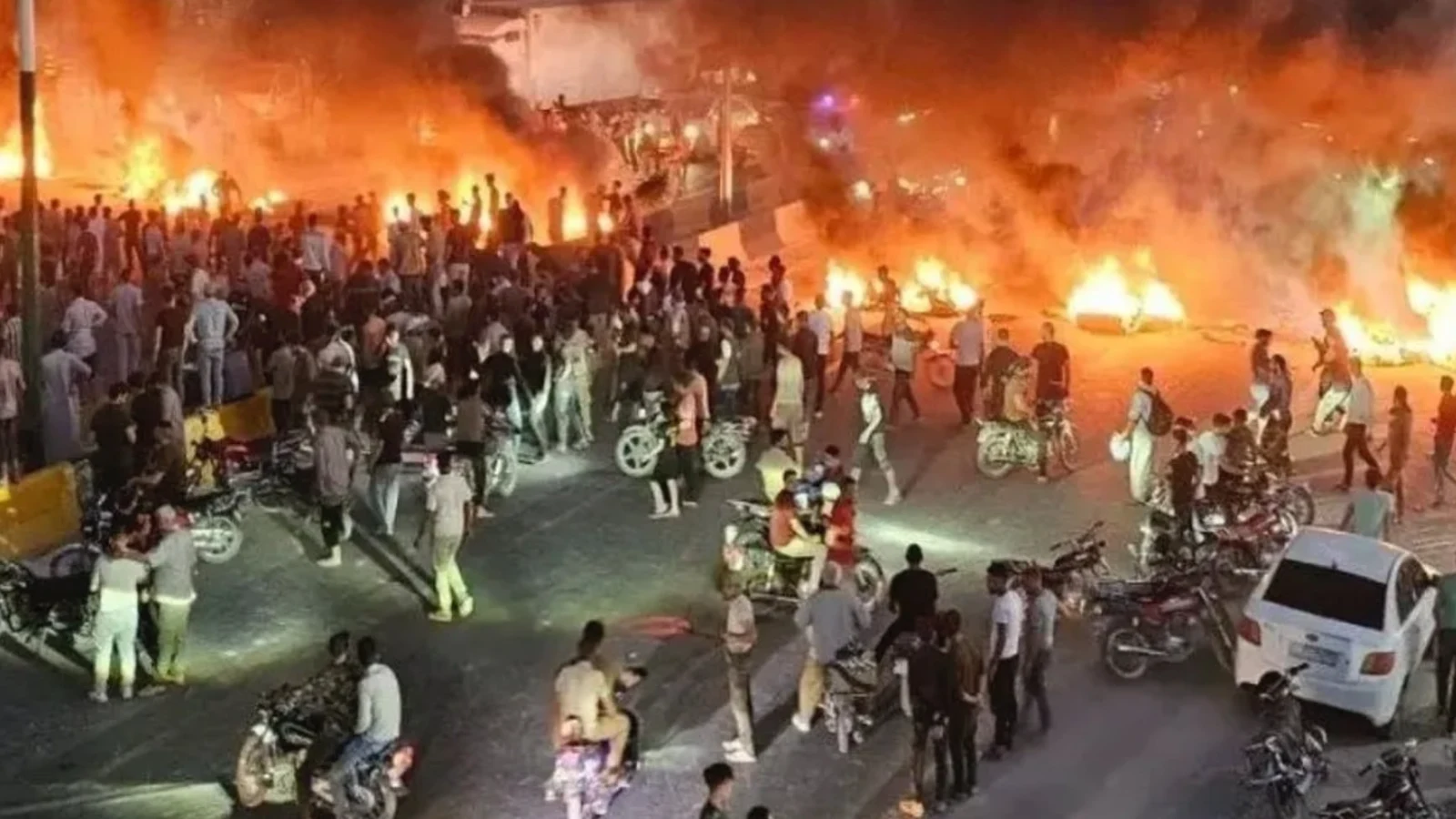
Angry protesters took to the streets in Idlib to reject an increase in fuel prices. In Maarat al-Numan, demonstrators chanted, “The people want the minister removed,” confronting the government with its first serious challenge of this kind. The anger is emerging from a region that the current authorities governed for years, one that served as a stronghold of the Syrian revolution and became a major source of support for the movement that eventually brought down Bashar al-Assad.
As the protests spread to parts of Hasakah, Raqqa, Deir ez-Zor and Aleppo, accompanied by roadblocks and burning tyres, opposition to the decision expanded beyond the demands of a particular profession or economic sector. The increase brought together people whose ability to work, travel and meet their daily needs has been directly affected.
The period following Assad’s fall had already witnessed protests over living and working conditions, including demonstrations by electricity workers in Idlib in 2025. The simultaneous outbreak of anger across several regions, however, along with Idlib’s prominent role, places the relationship between the authorities and society under direct political pressure.
Who Governs in Idlib’s Name?
Idlib’s particular position stems from the frequent conflation of its residents with the current authorities. The governorate’s name has gradually become shorthand for a political and administrative experiment that is invoked whenever the management of Syria is discussed. When government decisions are attributed to the “Idlib experience,” local residents are made to bear part of the responsibility simply because they lived in the territory where those decisions were once made.
Idlib Governorate received displaced Syrians from across the country and became a base for armed factions and institutions during the war. That history does not make its residents collectively responsible for the decisions of those who governed the area. Responsibility remains with those who possess the power to make decisions, while the availability of services and employment opportunities, along with residents’ ability to influence their own affairs, provides a more meaningful measure by which the experience should be judged.
The responsibility of the leaders who lived and governed in northwestern Syria is particularly significant because they are familiar with the details of the hardship that people are now being asked to endure once again.
The distance between Idlib’s political prominence and the conditions of its residents can be seen in the villages of Jabal al-Zawiya. In May, local official newspapers quoted the head of Al-Rami municipality as saying that villages in the area needed their electricity networks rehabilitated, water shortages addressed and roads repaired.
Residents who are still waiting for basic services to be restored must also pay for the alternatives they are forced to use. Higher fuel prices therefore add another burden to lives already strained by the cost of compensating for the services they lack.
Mounting Bills
The fuel decision reached households after successive rounds of price increases affecting essential needs. Some of their consequences became particularly visible when electricity bills were issued under the tariff adopted by the Ministry of Energy at the end of October 2025.
At the time, the price of household electricity was set at 600 old Syrian pounds per kilowatt-hour for the first consumption bracket, covering up to 300 kilowatt-hours per billing cycle, and 1,400 pounds for the second bracket.
At the same time, telecommunications costs prompted objections over the prices of data packages, the removal of hourly packages and the reduction of available options from around 200 packages to only 15. The ministry had asked the country’s mobile service providers, Syriatel and MTN, to explain the new packages and their prices.
The new fuel prices were announced on 13 September. The price of one litre of diesel rose from 125 to 175 new Syrian pounds, an increase of 40 per cent. Petrol rose from 152 to 195 pounds, an increase of approximately 28 per cent, while the price of a household gas cylinder increased from 1,470 to 1,600 pounds.
The increases therefore affected fuel used for transportation, production and heating, as well as the gas on which households depend for cooking. They added direct expenses to household budgets while also generating additional costs that will be passed on through goods and services.
The 2026 wage decree had granted a 50 per cent increase to categories of employees in the public and joint sectors and established a general minimum monthly wage of 12,560 new Syrian pounds. Comparing that figure with the new fuel prices reveals how limited people’s capacity to absorb the increase has become.
The Cost of Getting to Work
The consequences quickly appeared in public transportation. Fares for some microbuses operating on the Muhajireen–Al-Sinaa and Dweilaa–Baramkeh routes rose from 30 to 50 new Syrian pounds, although prices varied between vehicles.
The impact extends beyond those who use public transportation every day. Fuel is needed to operate tractors, irrigation pumps and generators, and to transport crops and other goods. The increase therefore enters the cost of agricultural production, trade and many forms of employment.
People Take to the Streets
The fuel increase can be understood as the measure that pushed accumulated anger into the streets. The cost of earning a living itself is rising for families that have already exhausted much of their ability to adapt.
When workers must pay more simply to reach their jobs, and tradespeople face higher operating costs, the real value of their earnings declines even if their nominal income remains unchanged. Opposition to rising prices consequently becomes tied to people’s ability to continue working and to live on what their work provides.
A Return to Donkeys
Against this backdrop, satirical social-media posts suggesting that Syrians may have to return to using donkeys take on a broader meaning. Their exaggeration reflects a fear of being pushed back towards forms of transport and daily life that people believed they would no longer need.
The humour that followed the increase also expresses frustration at the repeated expectation that households will simply manage and adapt whenever the price of an essential service rises. It assumes that family budgets always contain another expense that can be cut and that giving up one more necessity can remain a permanent answer to declining purchasing power.
Who Will Pay for Recovery?
In its justification for the decision, the Ministry of Energy said the increase was temporary and attributed it to the rising cost of imported petroleum products, shipping and insurance. It also cited comprehensive maintenance work at the Banias refinery, which is expected to continue for approximately two months. According to the ministry, imports currently provide around 60 per cent of the country’s diesel supply.
This explanation illustrates some of the difficulties the state faces in securing fuel. It nevertheless leaves the government responsible for explaining which alternatives it considered before approving the increase and how it assessed the public’s ability to bear its consequences.
Because the refinery maintenance had been planned in advance, those affected are entitled to know what reserves and financing were prepared for it and which alternatives were available to reduce its impact on the market. The authorities should also disclose the components of the pricing mechanism, including the fees and margins incorporated into the final price.
Describing the increase as temporary requires the government to establish a review date and clear criteria for reducing prices. It must also explain what support can be financed for public transportation, agriculture and the poorest households, placing citizens’ ability to pay at the centre of economic decision-making.
As of 14 September, the higher prices remained in effect, although the authorities had announced an upcoming review. The Ministry of Economy, meanwhile, said that the price and weight of subsidised bread would remain unchanged. It sought to offset higher production costs by reducing the price of a tonne of flour allocated for bread from 20,000 to 15,000 new Syrian pounds.
The measure protects one essential item in household spending, although it does not resolve the effects of the fuel decision on other daily needs. This gives added importance to the hearing with the Minister of Energy that the People’s Assembly bureau has scheduled for 17 September. Its significance will depend on the figures and calculations it makes public and whether it leads to a meaningful review of the decision.
ability to reduce the burden on those affected and by the clarity of responsibility for the decision and its consequences.
In Idlib, the government’s knowledge of the population and its living conditions makes accountability especially urgent. The years that the current authorities spent governing the region should have given them a detailed understanding of the limits of what its residents can endure.
This is where the political meaning of the current test lies. The authorities are being asked to listen to the objections of the communities they once governed and to reconsider their decisions accordingly. Syrians who have already paid the cost of war are entitled to know what share they will receive from the country’s recovery—and how long they will be expected to pay for it before its benefits reach their homes.