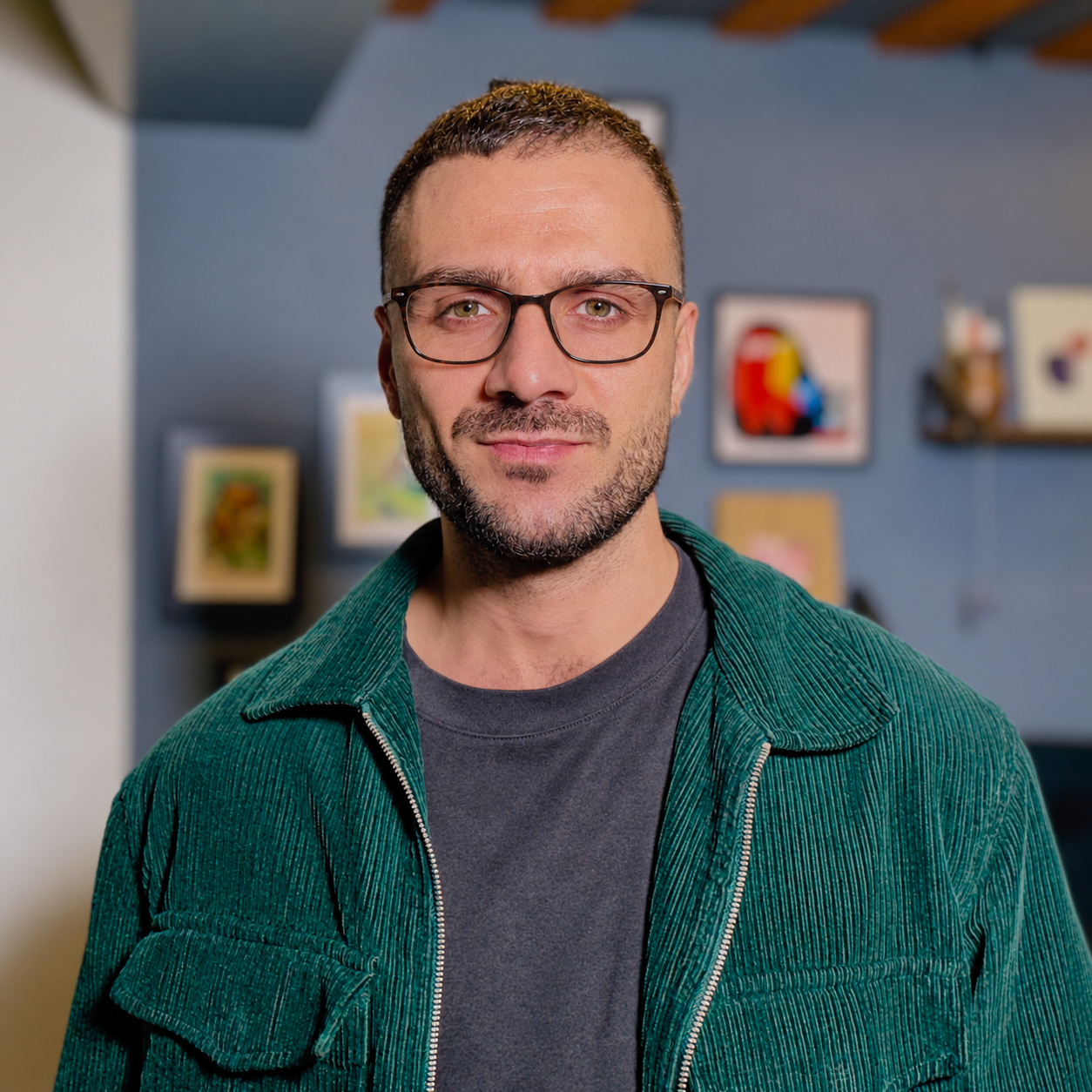
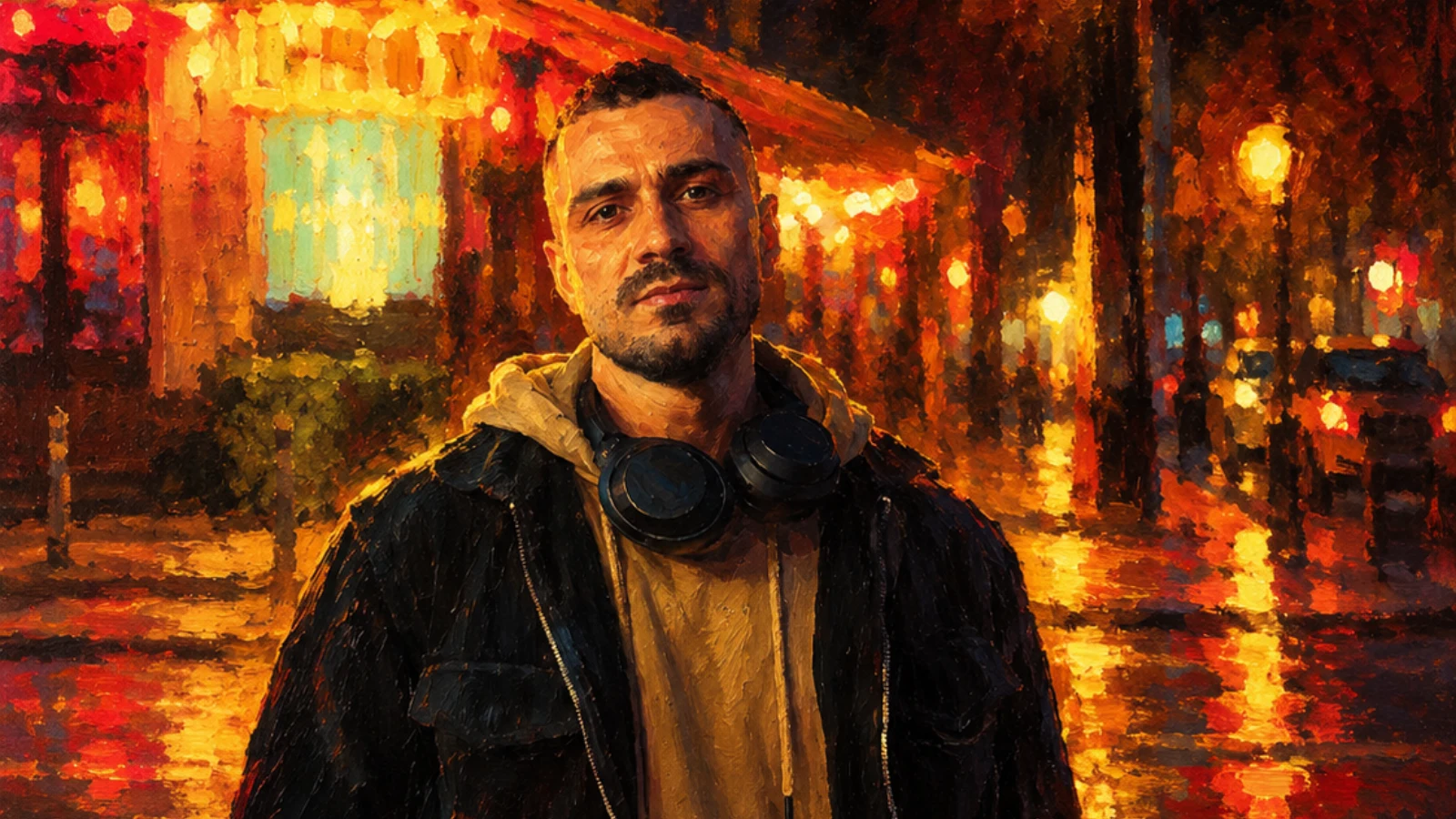
I have brain fog, and I mean that literally, not metaphorically. Sometimes it feels as though a thin layer settles between me and the world, not enough to hide things completely, but enough to soften their edges, like condensation on a window on a cold morning. I know the word I am looking for is somewhere inside my head, and I can almost see where it is, but I cannot quite reach it. A sentence begins clearly and then loses itself halfway through, and memories I once thought were firmly fixed start to resemble old photographs left too long in the sun, their colours slowly fading. The strange thing is that the same fog that makes so much inside my head look dull also makes light more beautiful. When evening comes, the city grows quieter and smaller details retreat into darkness; streetlights seem to stretch a little, illuminated windows become small islands suspended in the night, and the lights of cars and shops dissolve through my phone camera into coloured circles that look like pieces of candy floating in the air.
I love light. I love it the way moths and other flying insects seem to love it, especially in winter, when grey cities need almost any colour they can find in order to look alive. A yellow lamp above a doorway, red neon around a window, light reflected on wet asphalt; it does not take much to give a city another face. And at night, things are no longer exactly what they were during the day. Light removes some details, exaggerates others, and leaves enough empty space for us to see what we want to see.
There was a shopfront where I often stopped to take selfies. The owner had covered the outer glass with stickers that completely blocked the view inside, but he had outlined the visible frame with a red LED strip. I do not know whether the man had studied marketing or psychology, or whether he had simply discovered the same principle used by people who make insect traps: put something bright in the dark, and something will eventually move towards it. I would stand in front of the glass while the red light spilled over my face and clothes, and behind me the streetlights dissolved into soft coloured dots, like pieces of candy suspended in the air. In photographs, the place looked almost unreal, as though the ordinary street had suddenly split open and revealed another city behind it, one that appeared only after nightfall. For a while, I genuinely thought it was one of the most beautiful corners of the street.
Then I passed it in broad daylight.
For a moment, I did not recognise the place. The glass was dirty, the stickers looked cheap, the frame was dull, and the whole façade carried the kind of sadness that makes even looking at it slightly tiring. There was no parallel universe, no magic, nothing worth taking my phone out for; just an ugly shop on an ordinary street. The place itself had not changed. It had not lied to me at night or pretended to be something else. The light had hidden some details, emphasised others, and left the rest to my imagination.
Almost instinctively, I escaped into the park next door, which had its own irony because I had always found that park unsettling at night. It looked too wide, somehow empty even when people were there: drunk people, homeless people, men walking alone, others looking for sex or love or company, or simply anything that might make returning to an empty flat feel less heavy. One night I saw a man hugging a tree. He was not leaning against it or resting a hand on the trunk; he was actually holding it with both arms, the way we hold someone we have missed. My first thought was the easy sarcastic one: what kind of drugs is this man on? Then another question came, and it was not funny at all: what kind of loneliness makes a person living in a city of millions need to put his arms around a tree?
In daylight, the same park was full of life. Children were running, dogs were chasing balls, people were lying on the grass, and the trees that at night had looked like silent creatures waiting for something had returned to being simply trees. I sat down and felt the damp grass slowly seep through the back of my trousers, but I did not care. I put on my sunglasses and watched the people around me while the sun touched my cheeks and forehead with the softness of a kiss that wanted nothing in return. I kept thinking about the shop and the park: the place artificial light had made beautiful, and the place darkness had prevented me from seeing as it really was. Daylight had exposed more than the ugliness of the first place; it had also exposed how unfairly I had looked at the second.
Sometimes I wonder whether the problem with my brain fog goes deeper than the words I forget and the things that look faded. Perhaps it also interferes with the way I see beauty and danger; I have often found the two so close together that it becomes difficult to tell where one ends and the other begins. Human stories have placed them beside each other for centuries. Fire is beautiful. A violent sea can be beautiful. A storm seen from behind a window is beautiful. Even a cliff can become seductive if the view from it is spectacular enough. Icarus did not fall because he loved darkness; he fell because he moved too close to the sun. Perhaps life would be easier if harmful things arrived looking the way we expect them to. The problem is that some of them give us no warning of that kind; sometimes they are beautiful enough for us to approach them on our own.
And I think my relationship with light may not have started with light at all. Perhaps it started with my fear of darkness.
I was around five when I sneaked into my brother’s room and started playing with the old video player. I no longer trust myself on the title of the film; three decades are enough time for memory to rearrange names. But I remember exactly what it did to me. It was a zombie film, far too violent for a five-year-old: a party, then an attack, people being bitten and turning one by one, bodies being torn apart while their individual pieces seemed strangely unwilling to accept death. In my small mind, a severed hand could move on its own, an eyeball torn from a face could roll after me, a foot did not need the rest of the body in order to run, and even the small and large intestines were granted an independent life and some mysterious plan to hunt me down.
From that night on, darkness had inhabitants. A room after the lights went out was no longer simply the same room without illumination; it became another place governed by different rules. There was one possibility under the bed, another behind the door, a hand that might crawl down the hallway, a foot without a body, an eyeball that had chosen me, for reasons known only to itself, as its victim. I would switch off the light and run towards the bed, then jump under the covers as though a piece of fabric could somehow suspend the laws of the entire zombie universe.
I grew up, of course, and learned that a severed hand has more urgent problems than chasing me, that an eyeball removed from its socket would have difficulty navigating a hallway, and that neither the small nor the large intestine has the nervous system required to execute a sophisticated revenge plot. But the body does not always believe what the mind learns. Even now, when I am walking down a dark street and hear something behind me, I turn around. If the road feels emptier than it should, something old inside me starts listening. I know I am an adult living in a real city, and I know zombies are not waiting behind trees, but somewhere in my nervous system a five-year-old boy is still sitting in front of that video player, waiting for the severed hand to move again.
And yet none of the monsters I had prepared myself for ever arrived. No hand chased me. No eye rolled behind my feet. No intestine ambushed me from a dark corner. Darkness, despite all the years I spent suspecting it, mostly left me alone.
Some of the things that actually hurt me arrived illuminated.
Looking at it now, it makes sense that I grew up trusting bright places more than I probably should have. To a child terrified by what he cannot see, light is safety. Switch on the lamp and the monsters disappear. What can be seen feels less dangerous than what cannot, and what shines seems less capable of hiding something ugly. Without noticing, I carried a childish equation into adulthood: if something is lit, I can move closer to it. If it feels warm, I can trust it. It took me years to understand that harmful things do not always need darkness in order to hide.
Then I discovered that lamps are not the only things capable of burning us. Sometimes light is a person. Sometimes it is a city, a song, a bench in a park, a sudden rush of nostalgia, or the theme music of a television series that opens a door onto a life you thought you had already left. Sometimes it is a gentle voice that makes the whole body soften for a moment, only for the absence of that same voice later to become a hole you fall into. Sometimes it is Taylor Swift or Cigarettes After Sex. Sometimes it is a tiny piece of paper with a raccoon drawn on it, something that means nothing more than ink on paper to anyone else, but which can lift you into the sky one day and, a few days later, turn into a stone falling with you from it.
Memory is strange in this way; it does not care how much something weighs in your hand. A small piece of paper can become heavier than a house. A passing smell can reopen a room you thought you had locked years ago. A four-minute song can carry an entire life on its back. A bench in a park can bring back the person who once sat there. The opening theme of an old television series can rebuild a home that no longer exists. Sometimes a single word is enough to make the age inside your body change by ten years.
One day I was walking in the cold while the wind slapped my face and the rain hit my eyes and lashes until I could no longer tell where rain ended and tears began. All the water gathered in the same place and ran down my cheeks, and the strange thing was that the tears were warm, as though my body were producing its last private source of heat against the weather. Autumn leaves were moving around my feet, rising, spinning through the air, falling, then being caught by another gust and carried somewhere else. For a moment, I wished I were one of them. Not because I imagine leaves are happier than we are, but because they do not ask why they fell. They do not demand an explanation from the tree, replay the separation again and again, or stay awake trying to understand where they went wrong. They fall, and then the wind takes responsibility for what comes next.
In my headphones, Taylor Swift was singing So Long, London, and sometimes I hate her for exactly this reason. I hate her ability to enter a place I needed pages to understand and come out with one short sentence that makes me wonder whether I have written so much simply because I still have not found the right words. I hate her because when she gets it right, she gets it right in an irritating way; she takes something intensely private and compresses it into language that millions of people can sing, each of them placing a completely different life inside the same song.
And a note to anyone who dislikes pop music because they think that alone makes them deeper: perhaps first ask yourself why this music manages to enter so many radically different lives. Depth is not a genre, and obscurity is not evidence of sophistication. Please do not tell me you are refined simply because you do not listen to pop. Nicki Minaj, I imagine, also has a very clear idea of what refinement means.
Perhaps this is also why I love writing and fear it at the same time. Writing is one of the few ways a person can enter another person’s mind without knocking. I write a sentence, and someone I have never met can see the red shopfront I saw. I make them sit beside me on the damp grass. I take them into my brother’s old room and show them the severed hand that frightened me. I let them walk with me through the rain with Taylor Swift in their ears. After enough pages, they begin to know what scares me, what can make me cry, what a voice or a smell or a small piece of paper can do to my body.
But I know almost nothing about what is happening inside their head while they read. Perhaps they felt something. Perhaps they remembered someone. Perhaps they smiled. Perhaps they found me unbearably dramatic. Perhaps they closed the page three paragraphs ago and went to make coffee. And this is the part of writing that frightens me: I open entire rooms inside my head to other people, one after another, while all I get from the other side is a closed façade. It is as though I turn on every light in my house and then stand in the street staring at everyone else’s windows.
I do not know whether this is one of the reasons I keep writing, but the thought disturbs me and attracts me at the same time: I spent my childhood afraid of what I could not see, then grew up and began showing people what is inside my head so they could see it.
Light was also present in my paintings long before I understood any of this.
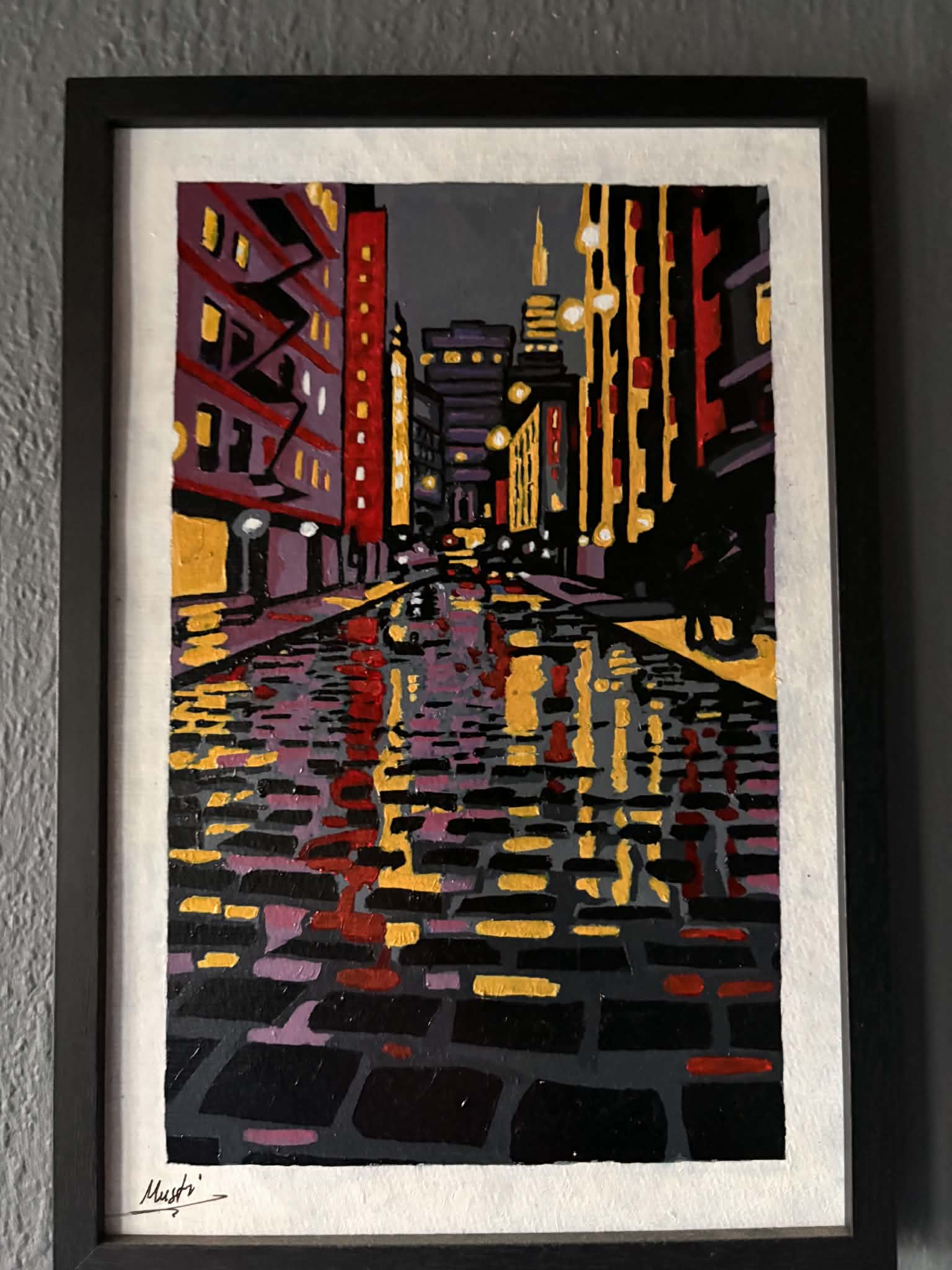
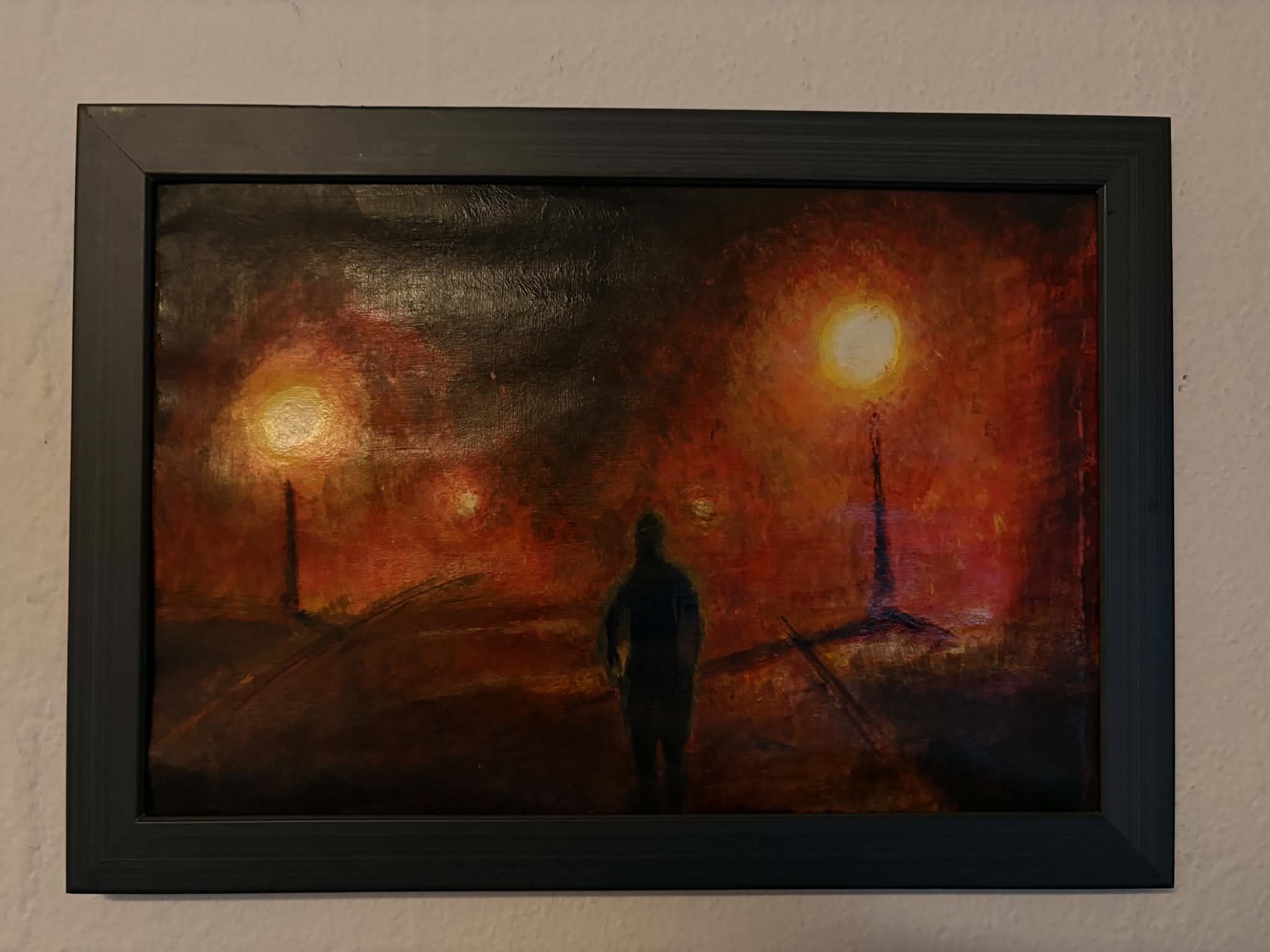
In 2018, I painted scenes dominated by red and black: night streets, distant lamps, wet roads, cities almost swallowed by darkness, and a solitary figure somewhere inside them. I thought I was painting light, but when I look at those paintings now, I think I was painting darkness too, or perhaps the uneasy relationship between the two. I could never allow darkness to become complete. I always had to leave a lamp, an illuminated window, a reflection on the ground, some distant point that stopped the night from consuming the whole painting.
The person in those paintings no longer looks like a stranger to me. I was that person. Alone, not looking back, but not moving forward either, trapped inside a moment that almost resembles a dream, or perhaps a nightmare that begins again every time I look at the painting. There is light ahead of me, but it offers no clear destination. It was guiding me, unfortunately, towards the unknown, not towards “the light” in the comforting sense optimists like to imagine.
And it is not only me. Even the words we use treat light as though it were the good side of the story. Truth becomes “clear.” Knowledge is “enlightenment.” We survive difficult periods by finding “light at the end of the tunnel.” Light, in the end, does not know where it is taking us. We are the ones who give it all these meanings.
Yesterday I took a photograph of myself at night. Behind me, light was scattered among shopfronts, streetlamps and trees. When I looked at it later, I immediately thought of my old paintings. In those paintings, I had always placed light ahead of the solitary figure or somewhere far from him, as though it were a destination he needed to reach. In yesterday’s photograph there was no single source, no glowing point calling me towards it. The light was simply spread around me. Looking at the photograph, a thought occurred to me that had never occurred while I was painting those old scenes: why had I always assumed I needed to reach the light? In the photograph, I was not moving towards it at all. It was already around me, and it was enough to let me see the street.
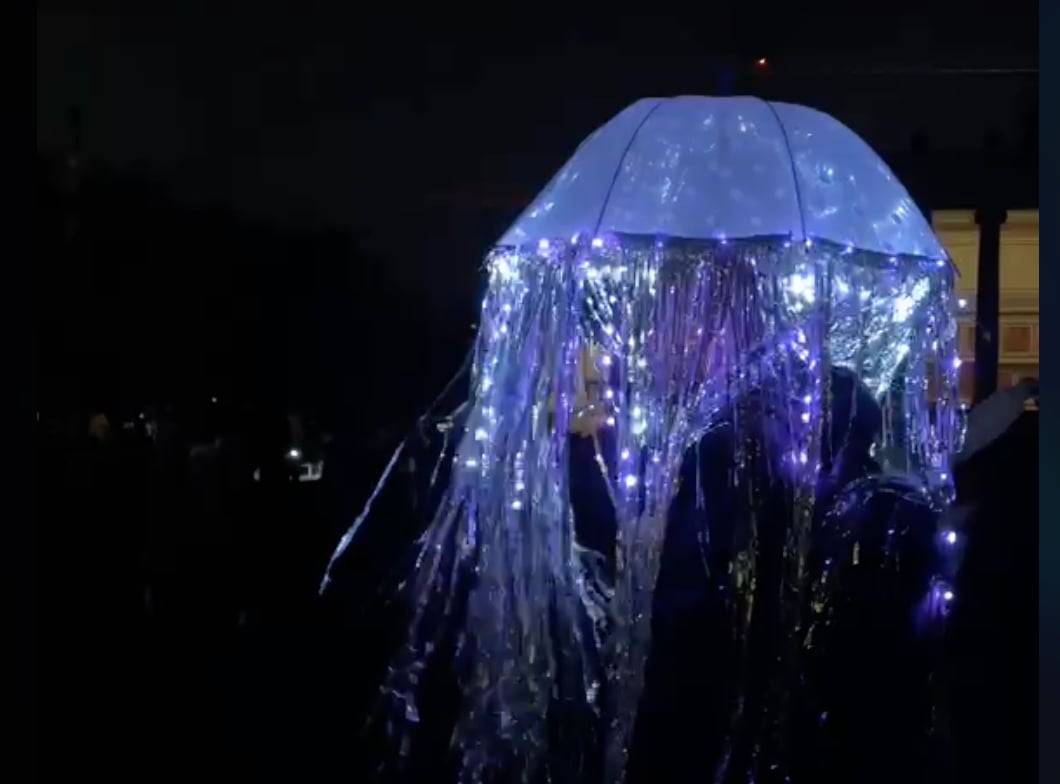
For a long time, I believed love was a gift, even a blessing. Then there were moments when I began calling it whatever I wanted: a curse. The words “I loved you” sometimes felt like a spell that destroyed my life every time I thought I had found a way out, something capable of lifting me high enough to make me believe I was flying, then breaking my wings in the middle of the sky. I do not want to rewrite those moments now just so I can sound wiser than I was. When love felt like a curse, it was a curse to me.
But later the word curse began to bother me, because it closed the case more quickly than I liked. If everything that happened was simply a curse, I would never have to ask why I went back, or about the times I saw the damage and stayed anyway. Why can a person remain close to something he knows is hurting him? Why does he feel the temperature rising and still insist on calling it warmth?
Perhaps because stepping away from light, for me, sometimes felt too much like returning to darkness.
Sometimes I think I was not moving towards light out of love for it every single time. On some occasions, I was running from something I imagined on the other side. And when we are running away from darkness, we do not always stop to ask where the brighter road leads. Sometimes the fact that it is brighter is enough to make it feel like an answer.
A moth does not know the difference between warmth and burning. It sees a lamp and moves towards it. It does not ask about temperature, appropriate distance, or attachment patterns. And a mosquito, as far as I know, does not book a therapy session after a difficult experience with a lightbulb.
I am not a mosquito, which may be the most ridiculous part of the story. I have language, memory, experience, and the ability to recognise patterns. I can even write thousands of words explaining why I approach the things I approach. And still, all that knowledge has not always prevented me from moving closer.
The strange thing is that none of this has made me love light any less. I still stop in front of neon. I still photograph streetlights reflected on wet roads. I still feel happy when the sun appears in Berlin after days of cloud. The red neon outside that ugly shop is still beautiful in the photographs I took there, and I still like those pictures. What has changed is that I no longer treat them as evidence of what the place looks like when the lights are switched off.
I want to learn to look twice: to see a place at night and return to it in daylight, and to ask whether something is truly beautiful or whether, at that particular moment, I desperately need it to be. And I want to allow darkness, sometimes, to be nothing more than darkness, rather than a storage room full of monsters.
The child who watched that zombie film still turns around sometimes on dark streets, but I can now smile at the irony. The hand never chased me. The eye never rolled behind my feet. The small and large intestines never carried out their mysterious plan to kill me. The zombies, after more than thirty years of preparation on my part, never showed up.
The darkness I feared all my life let me live. Some of the things that entered my life glowing, beautiful, warm and full of promise left burns behind.
The strange thing is that none of this has made me love light any less. Perhaps I am only beginning to learn something about distance. I can stand far enough away to watch it pass through the fog, spill across wet asphalt and give a grey city another colour, and then keep walking.
Because, after all, I am not a mosquito.
Comments
Comments are published after moderation. Your email address will not be shown.