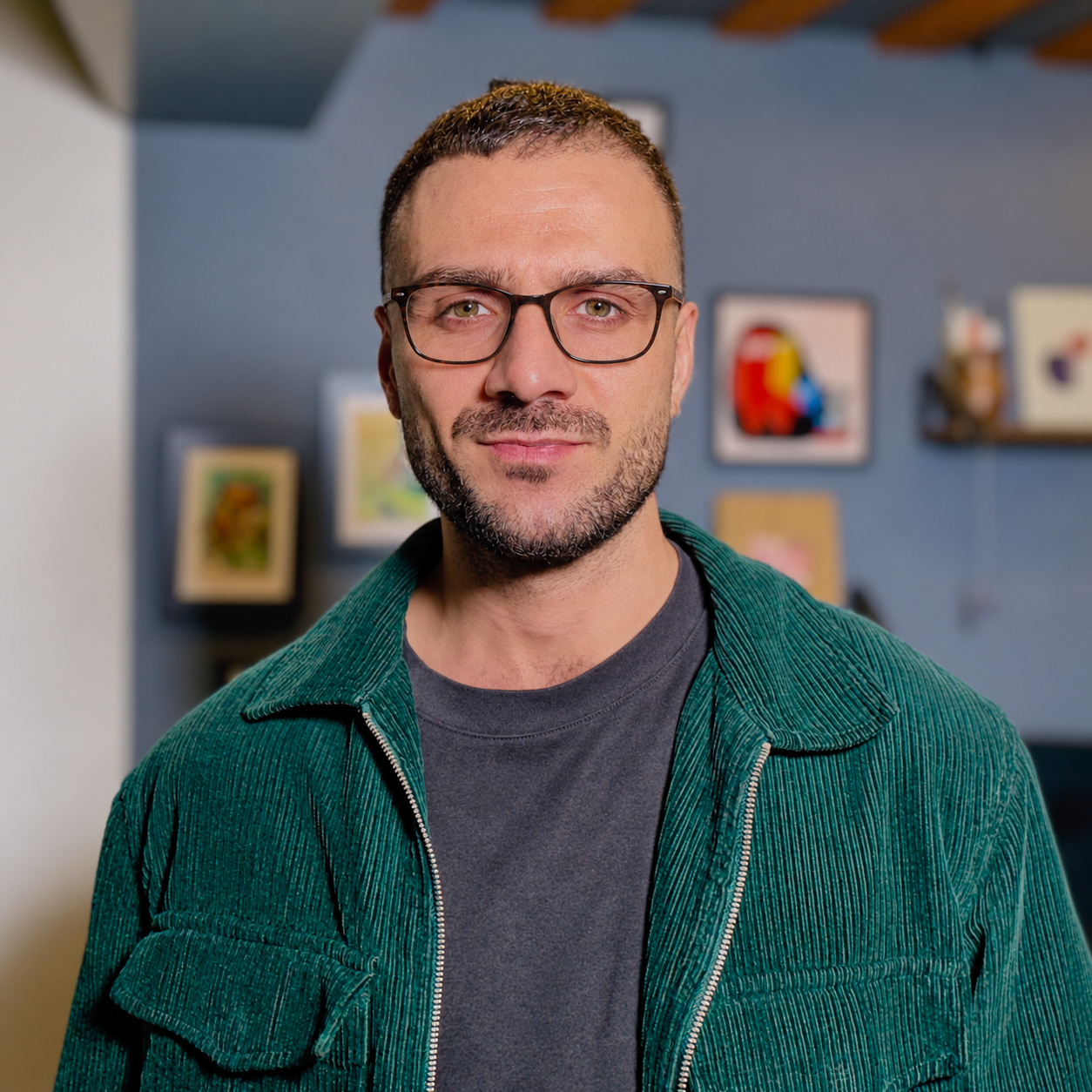
Yesterday, I took down the mirror that hung by my front door and broke it. It did not slip from my hands. I was not seized by a rage that sent me reaching for the first thing I could smash. I did it with an almost ritual calm, as though finishing a task I had put off for years. The mirror was already cracked. A long fracture ran along one edge, dividing the reflection without preventing the glass from doing its work. Every morning, I stood before it to fix my hair, study my face before going out, choose a shirt, then leave. At first, I noticed the crack. Then something happened that happens with things we live beside for too long: I stopped seeing it. The glass had never healed. I had learned to adjust the angle of my gaze until I could look past the break.
A few days earlier, a Pakistani friend told me that his mother believed keeping a broken mirror in the house brought bad luck. I laughed. I am not usually given to superstition, but the sentence stayed with me. Perhaps when we cannot get hold of our pain, we look for something solid enough to place between our hands. I needed to imagine, even for a moment, that misfortune could lodge in a pane of glass; that if I took it down, shattered it and carried the pieces out of the house, I might carry something else out with them, something that had been hanging here far longer than it should.
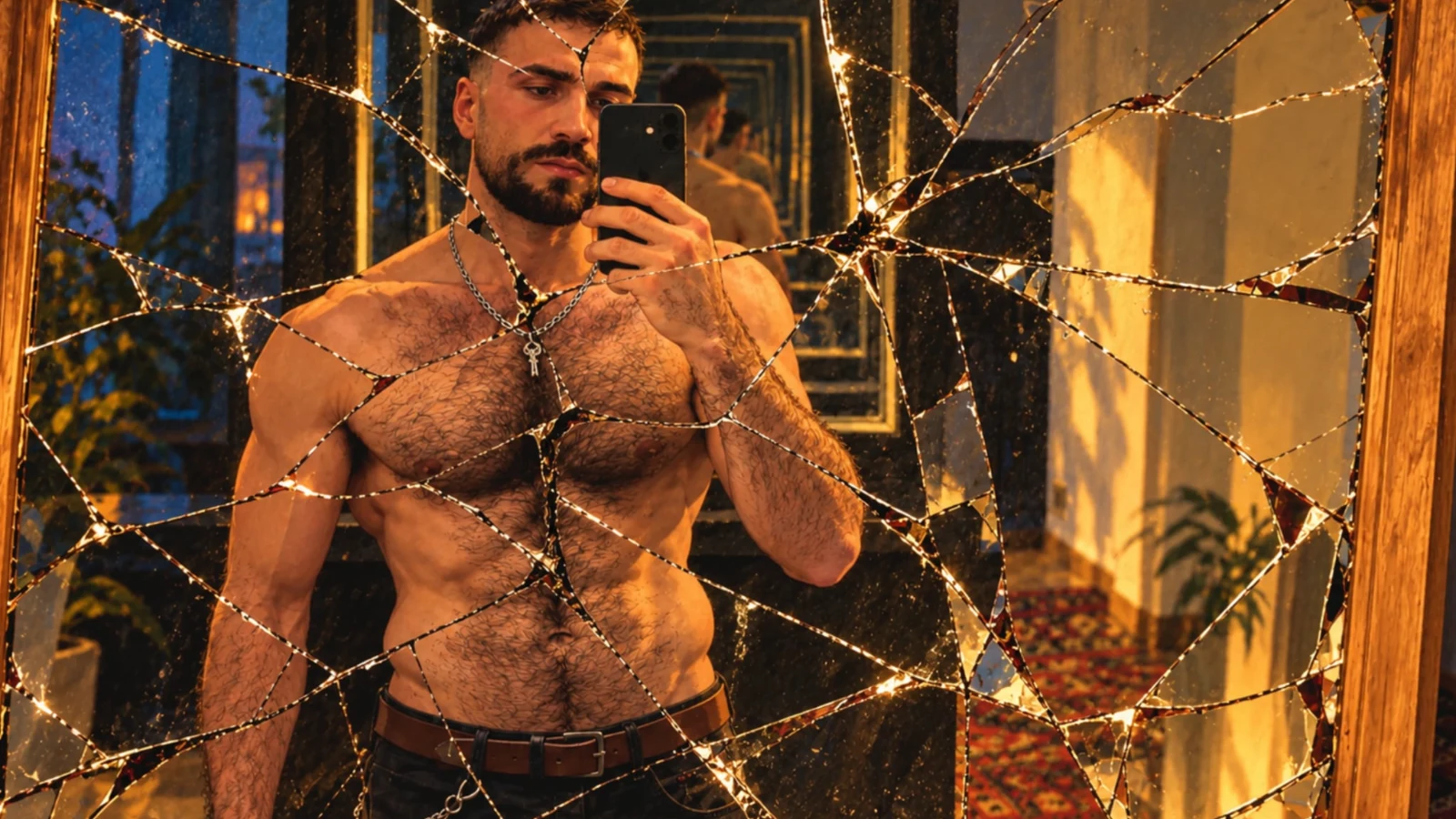
As I lifted the mirror, I remembered an old photograph I had taken of myself in front of it. I was bare-chested, a small key hanging from a chain around my neck. I had given the man I loved another necklace, with a lock. We found it romantic, with a simplicity that almost makes me ache for us now: he had the lock; I had the key. The photograph was set to “The Boy Is Mine” from Ariana Grande’s Eternal Sunshine, an album that became part of the inner music of our relationship for years. Everything in that photograph seems, now, to have known the ending before I did: a cracked mirror, a key suspended over my heart, a song claiming the boy as mine, an album promising an everlasting sun. I saw the key. I saw my body. I saw love. The crack was the one thing I did not see.
Perhaps that is why I loved the name Eternal Sunshine so much. I had already given the man I loved a name made of light. In my writing, he became “my sunshine” and in my life the name meant more than an endearment exchanged between lovers. At times, I treated him as though a person could become a force of nature: something that returns however far it travels, that clouds can conceal but never extinguish, something we lift our faces towards, certain it will still be there. I built part of our relationship around the songs on that album, fastening photographs, places, clothes, faces and entire nights to them, until the music itself became an archive of a life I thought I would always be able to return to.
But my history with the sun goes back much further, On 24 October 2012, I came out of a solitary cell after forty days in detention. I had been arrested by militias loyal to the Assad regime, one of the hundreds of thousands of Syrians swept into detention during the revolution. We had wanted freedom, that alone was enough to imprison us. Perhaps my sect and my birthplace had counted against me too: I belonged to a community the regime had long hated, and I came from Idlib, a city towards which the Assad family’s hatred seemed to pass from one generation to the next. During those weeks, there were moments when I thought sunlight had become a privilege reserved for other people. I lived behind a small door through which I heard screams, prayers, groans and crying, surrounded by a smell some part of my memory can still summon today. I was released that evening and reached my sister’s home in Jaramana. I trimmed the beard I had been forced to grow for forty days, then lay down on an ordinary mattress that seemed to me the most luxurious place in the world.
A few hours later, at three in the morning, violent knocking woke me. The men outside said they were “soldiers of the homeland.” I opened the door. The first fist reached me before understanding did. My body, already stripped of so much weight during detention, fell to the floor. Four men came in, blindfolded me and took turns beating me with their fists, their feet and the butts of their rifles. I remember the stairs I tumbled down more clearly than their faces, because I never saw their faces at all. I remember the wall meeting my body at each turn, the trunk of the car into which they forced me, bound, my head pressed towards my knees. The car swung me from side to side while my mind wrote one possible death after another, each only minutes away. I remember the blood warm on my face, its salty taste. More than anything, I remember the sound of a gun being cocked behind my head after one of them gave the order to kill me.
Strangely, I did not cry. I did not scream. I did not feel fear in the way you imagine you will when you believe your life has only seconds left. For years, I thought that had been courage. Later, I learned that the body has more complicated ways of keeping us alive. When terror exceeds what we can bear, strength is not always what comes to our rescue. Sometimes, our capacity to feel begins to close down. The mind locks certain rooms, lowers the volume, suspends parts of consciousness and postpones the reckoning until the body can pay.
I paid that price later. I left for Lebanon, entered therapy, began taking antidepressants and needed months to learn that a knock at the door did not always mean armed men were waiting on the other side. Then I returned to Syria, to journalism and politics, to work and people, including people who helped me see the world beyond the window of my trauma again. Over the years, Jaramana became something I could write about; it no longer happened to me anew every night. And with the particular innocence of someone who has survived something terrible, I assumed that night would remain the outer limit of pain in my life. I had looked at death from close enough to ask myself: what could possibly be worse than this?
I did not yet know that pain observes no such fair arithmetic.
There is a difference between being hurt by an enemy you recognise as an enemy and being hurt by the person before whom you have laid down your arms. The men who beat me in Jaramana had never told me they loved me. I had never fallen asleep with the smell of their skin around me, cooked for them, waited for their morning messages or built a private language with them. I did not know what their faces looked like when they were tired, laughing or asleep. After they were gone, I did not have to go back through our memories and ask which had been real and which were merely stops along the way to something else. An enemy gives fear a clear direction. Love can teach it to hide in the very place we go looking for reassurance.
So I can say today, without arranging different kinds of suffering into some hierarchy of catastrophe, that the psychological exhaustion and emotional abuse I experienced in this relationship were, for my body and my mind, harder to endure than some of what happened to me when my life itself was at stake. I survived the cell, the beating, the trunk of the car and the gun behind my head. Years later, I found myself sometimes helpless before a small phone: a message, a withdrawal, a return that opened everything again, a departure that left it all open. I am not saying the man I loved was more brutal than the men who turned their weapons on me. Those men had never first made a home in my heart. Pain that comes from outside drives you to protect yourself. Pain that comes from within love confuses the very instinct of self-preservation, because the person undoing you is sometimes the same person your body wants to run to for relief.
Even so, I refuse to lie to myself and paint those years entirely black to make the ending easier. I was happy with him. I loved, I laughed, I felt a closeness that was real. We made a small life out of details no separation can travel backwards through time to erase. There were beautiful nights, meals, laughter, a bed that grew familiar, a language nobody else understood, names the rest of the world did not use for him. I called him “my sunshine,” “Bobo,” and other things only intimacy could have invented. Those words mattered because each held a little history known to just two people.
But those three years were never one unbroken story. They were a series of approaches and retreats, of breakups and returns, until coming back became part of the relationship’s very structure. Each time I began to learn the shape of his life without me, and mine without him, another possibility appeared. Each possibility rearranged me from the beginning. After one breakup, he returned to my life and said plainly that he did not want to date exclusively. I knew what that meant. I knew there was someone else in the picture, someone I had introduced him to myself. Still, I accepted the closeness he offered. Sometimes he spent three nights in a row at my home, sitting at his computer for hours, working on a medical case he wanted to prepare for publication. I cooked, moved around him, went about my day. His presence was enough for me.
I knew he could leave my home for another life. I knew it hurt, and I accepted it because, then, having him beside me seemed less painful than having none of him at all. I kept stretching my definition of love to accommodate what did not fit me, shrinking my needs to fit the space he was willing to give. I do not look back on that version of myself with contempt. I was in love, and so afraid of loss that I began bargaining over things I knew, somewhere deep down, were hurting me. Nor was I simply a victim of what happened. I stayed. I returned. I helped sustain a cycle I could have stepped out of more than once. For a long time, I believed love was measured by the ability to remain, that the most faithful person was the one who could endure the most. It took me a long time to understand that some of what we call devotion is fear of an ending dressed in love’s clothes.
When he came back this time, it took only a week. Three meetings were enough to begin reopening the rooms I had closed during the previous months. One was a quiet, romantic dinner. We prepared the food. I lit a candle and sat opposite him, instead of beside him in front of the television as we used to, because I wanted to see him. I told him I wanted to sit facing him this time so I could look at his face. We talked, laughed, drew close, then returned to the kind of intimacy the body remembers before the mind. He slept beside me. I held him in the old, familiar way. In the morning, I left for work while he was still asleep, and when I came home later, I found a small note he had left me. It had been a lovely night. Perhaps that was what made the days that followed so much harder.
In one week, the relationship consumed all the energy I had spent three months trying to recover. The fear returned, the long messages, the defensiveness, the explanations, the attempts to soothe, the search for a sentence that would not make things worse. Each of us wanted the other to see his version of events. The more we explained, the further apart we moved. I went to work sick with the strain and came home to another round of words waiting for me. We had not yet begun a new life together, yet my body was responding as though an old collapse were happening all over again. One week was enough to send me three months backwards. Then it ended with almost the same sentence I had spent those years trying to escape: we will not be together; I will not see you again.
On that last Friday, I had gone to work happy. I believed we would see each other afterwards, calm down, put what had happened into perspective and find out whether we could continue differently. I carried a kind of optimism that hurts to remember now: I thought the day was moving towards a meeting, while another road was already going dark. He told me he would not see me, that he had other plans. Then the digital doors began closing, one after another. It is strange how a relationship that takes years to form can disappear from a phone screen in seconds. Blocking someone erases nothing from memory. It cannot remove their scent from a pillow or cut years out of a nervous system. It closes a passage. For the first time, I did not go looking for a side entrance.
I asked him to leave my life and not try to contact me again. I was tired of explaining myself, of trying to calm his fear and my own, of repairing something only to discover, each time I mended a wall, that the ground beneath it was moving. I no longer wanted to write one final speech setting out everything I had done for him or everything he had done to me. I was too exhausted to search for a beautiful ending.
In the days that followed, I thought about karma. I do not entirely believe in it, but when you have been wounded in love, sometimes you need to imagine a witness who had no part in the story: something that saw what the other person could not, or would not, see. For a moment, I wished that one day karma might sit beside him when he came across my name, found something I had written or heard an old song in a shuffled playlist, and make him remember. I do not want him to fall apart. I do not need the world to punish him to make my story just. But I hope that one day a tear will fall where nobody can see it, and he will quietly say to himself: I am sorry, Musti. I was not emotionally steady enough. I did not understand how much I was hurting you.
I also hope he stops before doing to the person who comes after me what he did to me. I have no wish to become a saint in his memory. But pain we fail to understand so easily becomes an inheritance we pass from one person to the next. Life will take from him as it has taken from me, and give to him as it has given to me. It will teach him things I could never teach him, however much I wrote or wept or explained. Perhaps some of the hardest lessons arrive when we discover that someone who loved us is no longer waiting in the place we once knew we could return to.
As for me, I no longer want to spend the rest of my life trying to decide whether he truly loved me. Perhaps he loved me in his own way. Perhaps he loved the fact of my presence more than he loved me: someone who knew him with such precision, who listened, fed him, held him, read his moods in the smallest movement and offered a place to return to when he needed warmth. Perhaps he loved how the relationship made him feel more than he loved the responsibility of caring for it. Perhaps I am wrong about all of this. I no longer want to enter his inner life and deliver a final verdict on his feelings. Whatever the right name for what he felt, the way it reached me wore me down more than I want any love to do again.
Then Ariana returned to my story from an unexpected direction. After the years of Eternal Sunshine, she released another album, Petal. In the song “stay,” I paused at a small phrase: she did not want to be “another corrective experience.” The words stayed with me because they named a role I had grown tired of playing in other people’s lives. I was tired of being the experience through which someone else discovered who they wanted to become: the person who entered their life in a time of confusion, helped them name their fears, saw in them what they could not see in themselves, waited for them to come back to themselves, then watched them go on, better prepared for a life that would begin after me.
For so long, I had loved being that person. Helping someone I loved see the world differently made me feel valuable. So did knowing I had left something of myself in them. Perhaps there was a kind of vanity in it too, in imagining I could be the one to wake other people from their sleep. But I had not asked myself often enough what it cost to make myself so necessary. How many times had I become a bridge for another life to cross? How often had I been the most consequential supporting character in someone else’s film—the one who enters halfway through, changes the protagonist, makes him more aware of himself, then disappears so he can begin the final act without me? How often had I remained on the first bank, having made sure everyone else reached the other side?
I do not want that anymore. I do not want to be someone’s “corrective experience,” the person whose body becomes the ground on which they learn about love, fidelity and loss, before carrying that knowledge into their next relationship. I do not want to be a resting place on someone else’s journey, a temporary home they return to when the world exhausts them, then leave as soon as they recover their appetite for travel. I want to be the protagonist of my own story. I want to discover the shape of my life when my part is no longer to rescue someone, wake them or help them become a more complete version of themselves.
Perhaps that is why I came back, in the end, to the mirror. I stood before the crack my eyes had learned to overlook and remembered the old photograph: my body, the key, the song, the man who believed something beautiful could become eternal if he loved it enough. I understood then that the most dangerous broken things are often the ones that continue to work. When something shatters all at once, we usually know what to do: gather the fragments and throw them away. But a mirror can still return your face despite the crack. A relationship can still give you moments of joy while draining you. A promise can lose half its meaning and retain just enough to keep you waiting. We grow so accustomed to the break that we stop seeing it. Eventually, we begin to believe the line running through the reflection belongs to our face.
I broke the mirror, gathered the pieces into a bag and carried them out of the house. Nothing miraculous happened. The air did not suddenly change. Those three years did not leave my body with the glass. The memories remained. What had been beautiful was still beautiful; what had hurt still hurt. But the place where the mirror had hung was empty. For the first time in a long time, I did not feel that emptiness was a catastrophe I had to hurry to fill.
As I write, I understand something else about names. No one will call him quite as I did. Other people may come, may love him, may give him new names. But when I called him “my sunshine,” the words belonged to a world that has ended. “Bobo” belonged to a language made by a life that no longer exists. That version of him—the one who lived with me, ate in my home, slept in my arms, wore the lock while I wore the key and laughed at things only we understood—has ended too. You can leave a person, but you cannot take with you the life they made around you. Some things cannot be carried into the next relationship. They were never quite qualities either of us possessed alone; they were a third living thing two people made together, which died when they parted.
Perhaps that is why I no longer feel that my loss is the whole story. He has lost something too, whether he understands it now or years from now. No one else will carry the same memories of me, just as no one will carry the version of him that I knew. His life may be more beautiful after me. Mine may be more beautiful after him. But what we lived cannot be reproduced. Life does not make copies, however faithfully we book the same journeys or repeat the same words with someone new.
Soon, the sun will rise. I look at the moon still suspended in the sky and think of the whole distance between Eternal Sunshine and “stay”: between the man who wore a key against his chest and believed love could be an everlasting sun, and the man standing before an empty place on the wall, beginning to understand that the light had never belonged to the person he called his sunshine.
When morning comes, I will open the window and lift my face and chest towards the light. I will not ask the sun to promise it will stay. It has no need to promise me anything. It disappears every evening, yet I have never learned to fear its absence. I know it does not go away to test how much I love it, or return to see whether I am still waiting. It rises, sets and returns in a rhythm that asks no one to prove their worth.
The man I used to call my sunshine has left my life. I will not call him that again. I will not call him “Bobo.” The life we had will not return, however clearly I remember it. What remains will be what so often remains of the things we have loved honestly: a few photographs, songs whose meanings have changed, a small key, an empty place on a wall and an earlier version of ourselves we can never return to.
When I sent my final message, I had nothing more to say. After all the explaining, all the returning, all the fear, all the attempts to save something I once believed love alone could save, I had no need for a metaphor or a literary ending. I needed only to say the simplest truth I had left:
I have been through a lot of misery because of you.
Comments
Comments are published after moderation. Your email address will not be shown.