I called him My Sunshine. It was a name I loved saying, partly because of the smile it brought to his face and partly because it seemed to capture something I had never quite managed to put into words. I once sent him Whitney Houston’s “I Have Nothing,” hoping he would hear in it what I felt whenever I looked at him. At the time, calling someone my sunshine felt like the most natural thing in the world. I had no reason to wonder what would become of all that light if, one day, he were no longer beside me.
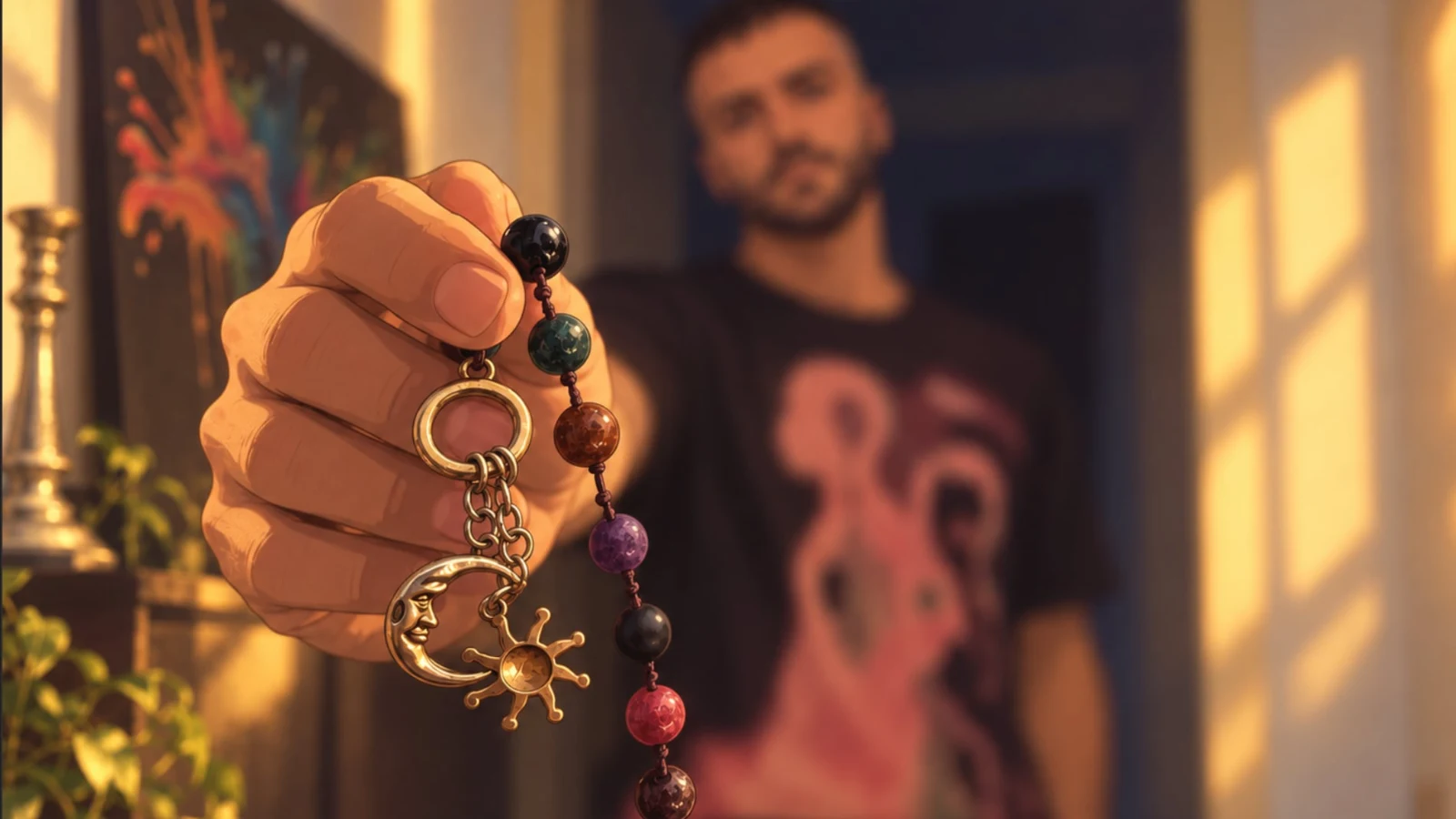
We bought two necklaces: a gold chain with a sun pendant for him, and a silver one with a moon for me. The pendants were designed to fit together, their separate curves forming a circle when placed side by side. He wore his sun, and I wore my moon. Sometimes, without thinking, I would reach for the pendant resting against my chest and smile at the thought of him wearing its counterpart somewhere else in the city. I loved that each of us carried a symbol of our own, and that whenever we brought them together, something new appeared between us. It was a private little ritual, so simple that I never imagined how much I would miss it.
The sun and moon seemed like an unlikely pair to choose as symbols of togetherness. From Earth, we watch them move across the sky, appearing to follow one another without ever sharing the same path. During a solar eclipse, the moon passes in front of the sun, and for a few extraordinary minutes their outlines seem to meet. Then the shadow moves on, daylight returns, and the moment is over. Our pendants obeyed no such celestial rules. Whenever we wanted, we could reach towards each other and bring them together, making a perfect circle no larger than a coin. I loved that small movement of our hands, the ease with which we could create a meeting that the sky allows only for a fleeting moment.
Being with him changed the way I experienced the world around me. I could be sitting in an unfamiliar room or walking down a street I had never seen before and still feel that I was somewhere I belonged. Sometimes we would talk for hours; at other times, he would be absorbed in something of his own while I sat nearby, happy simply to have him there. I loved the ease of those moments, when we needed no particular occasion to enjoy each other’s company and silence felt as comfortable as conversation. Gradually, Berlin acquired a private geography of its own. Certain streets reminded me of things we had said there, familiar corners brought back his laughter, and places I might once have passed without noticing became somewhere I wanted to return because we had been there together.
One of those places was a market held twice a year along the River Spree, where we bought a pair of shell-shaped earrings. I remember him pronouncing the word Promenade in an exaggerated, theatrical voice, as though he had stepped straight out of Bridgerton. It made me laugh, so he said it again. Soon I was asking him to repeat it just to hear him do it, and the word became one of those little jokes that belonged to us. Nothing particularly remarkable happened that afternoon. We walked by the river, looked at things for sale, bought the earrings and amused ourselves with a word. Yet I would give a great deal to return to that ordinary day, to hear him say Promenade once more and know that I could ask him to repeat it as many times as I pleased.
Perhaps this is how someone comes to feel like home. Their presence gradually becomes part of the world we inhabit, until familiar places are filled with memories of them and even the smallest details acquire a meaning they never had before. A street becomes the place where we once held hands. A song brings back a particular evening. A word, spoken in a certain way, carries an entire afternoon within it. We never consciously decide to fill our surroundings with these reminders. They accumulate quietly while we are busy living, and only when the person is gone do we discover how much of our world has come to belong to them.
After we separated, I stopped wearing my moon necklace and the shell-shaped earrings. I had worn the necklace for so long that, for a while, I could still feel its weight around my neck. My hand would move towards it out of habit and find nothing. I put it away because I could no longer bear to catch sight of it in the mirror every morning. I wanted to be able to begin a day without immediately remembering what I had lost, although I soon discovered that removing an object was much easier than escaping the memories attached to it.
A few days ago, I saw a photograph of him wearing the same gold chain, but the sun pendant was no longer attached to it. He was still wearing the shell-shaped earrings we had bought together. I found myself looking at the photograph for a long time, first at the earrings, which brought me straight back to the market by the Spree, and then at the chain resting against his skin. I knew that chain so well. I had seen it on him countless times, had touched the sun that once hung from it, and had held my moon beside it to make our circle. Seeing it without the pendant brought back the familiar ease of being close enough to reach towards him and touch it, a gesture that had once required no thought at all.
I do not know why he removed the sun, or what the things he still wears mean to him. Perhaps he remembers the afternoon we bought the earrings whenever he puts them on; perhaps they have become ordinary objects he wears without thinking. A photograph cannot tell me any of that. What I know is that seeing those familiar pieces of jewellery brought back a part of our life together with an intensity I had not expected. I could hear his voice saying Promenade, remember the sound of my own laughter, and almost feel the movement of our hands as we brought the sun and moon together. My necklace was somewhere in my home, put away, and his sun was no longer on the chain. Yet the circle remained perfectly clear in my memory, as though both pendants were still lying in the palm of my hand.
I sometimes wonder what becomes of the small world two people create together when they part. What happens to the words they invent, the places they love, and the objects they buy while imagining that they will have years to enjoy them? The market continues to return to the river twice a year, and Promenade still means what it has always meant. Anyone could buy a pair of earrings like ours. But I cannot separate that word from his voice or that market from the afternoon we spent there. The memories have become part of how I know those places and things, and I suspect they will remain with me long after the details of other, seemingly more important days have faded.
I miss him in ways I can anticipate and in ways that still surprise me. Sometimes something happens during my day and I immediately want to tell him about it. Sometimes I see something funny and know exactly how he would react, only to realise that I can no longer turn towards him and watch his face. I also miss the years we never had: the ordinary mornings, the familiar routines, the new jokes that might have joined the old ones, and the changes in our faces as we grew older together. I had imagined a long life with him. I wanted to discover who we would become, what would make us laugh in ten or twenty years, and whether he would still say Promenade in that same ridiculous voice.
I still love him, and I have no wish to diminish what we shared simply because it came to an end. There were days when I felt profoundly happy beside him, when the thought of growing old together seemed so natural that I hardly needed to imagine it. I wanted more of those days, more time to discover the person he would become and to let him discover the person I would become in return. I cannot know what that life might have looked like, but I know how deeply I wanted to live it with him. Perhaps that is why the smallest reminders can still hurt so much: they bring back a love I remember vividly, along with all the years I once believed were waiting for us.
When I think of our necklaces now, I remember the little ritual of bringing them together. One of us would hold out a hand, the other would move closer, and the sun and moon would form their circle. We would admire it for a moment before letting the pendants fall back against our chests. I never thought much about that last movement. I was too happy with how easily the circle came together, with the fact that whenever I reached towards him, he could reach towards me, and there it would be again.
I no longer wear my moon, and in the photograph I saw, his sun was gone. Still, whenever I remember our necklaces, I see them as they were when we held them together. I remember the shape they made, the closeness of our hands, and the happiness I found in something so small. Somewhere along the Spree, there is a market I will visit again. Perhaps I will pass the stall where we bought our earrings, or hear someone say Promenade and find myself smiling at the sound of a voice that exists now only in my memory. For a moment, I will be walking beside him again.
Comments
Comments are published after moderation. Your email address will not be shown.