
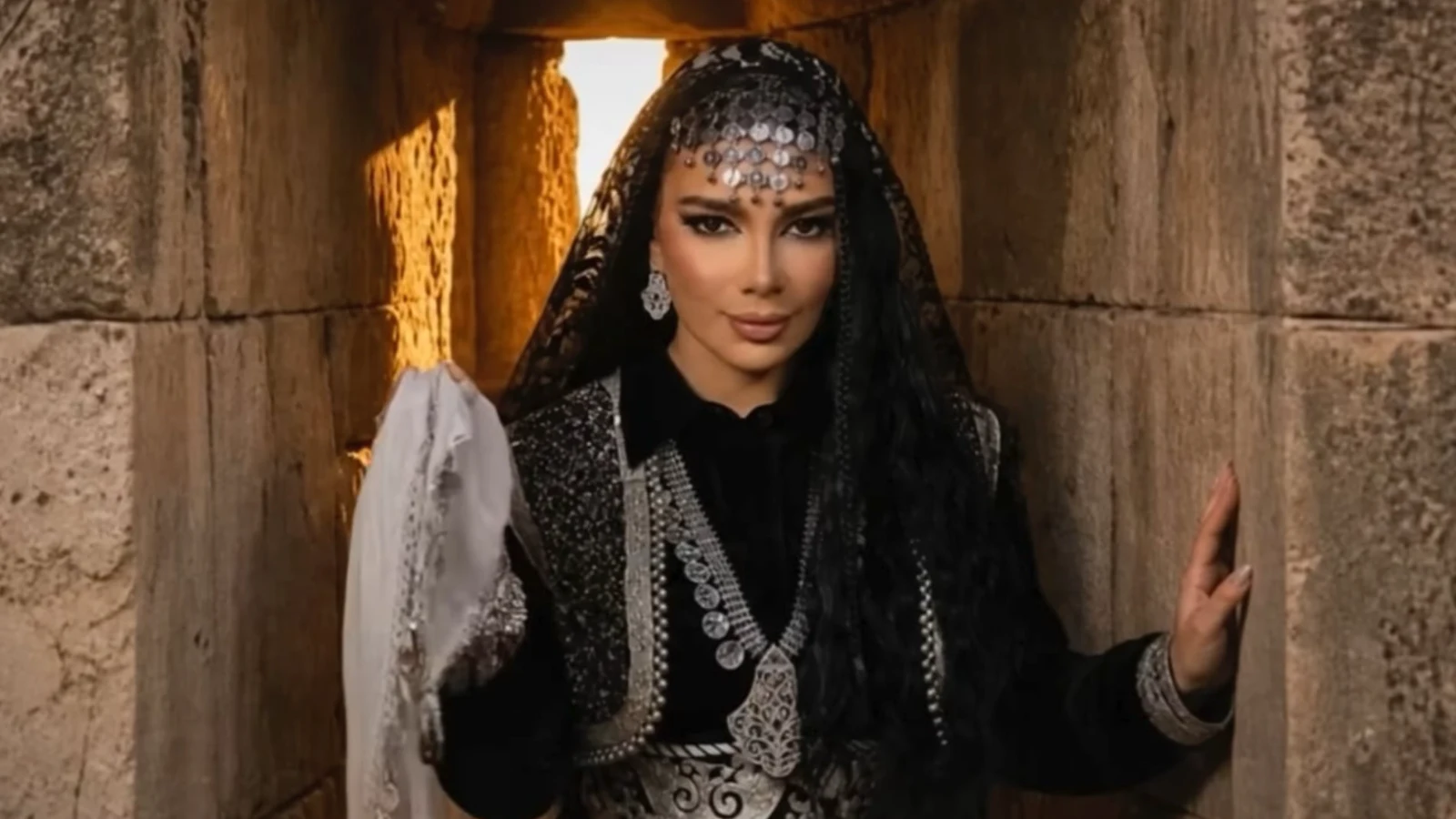
Syrians needed little time to find a song of their own in the Syrian Album released by Assala Nasri. People from Sweida shared "Mahboub Albak," while those from Hama rediscovered the Orontes River through "Wallah La'abbi El Jarra." Residents of Deir ez-Zor circulated "Amda," and people from the Damascus countryside found their own villages and the people of Eastern Ghouta reflected in "Al Reef Al Shami." The response resembled a celebration in which each province embraced the moment it heard its name and dialect in the voice of one of the Arab world's most prominent singers.
Released by Rotana, the album features 14 songs drawn from Syrian folklore, with one dedicated to each of the country's provinces. Its release preceded Assala's return to Damascus, where she was scheduled to perform at Al-Fayhaa Hall on September 17, 2026, after an absence of approximately 15 years.
Final preparations for Assala's Damascus concert were underway on September 16, ahead of her long-awaited return to performing in Syria after more than 15 years. Accompanied by her band, Assala began intensive rehearsals in preparation for a concert that Arab media would describe as legendary.
Redefining Syria
The significance of the project extends beyond the timing of its release. The album arrived at a moment when Syria was attempting to redefine itself following the fall of the Assad regime, amid unresolved issues involving the coastal region, Sweida, and northeastern Syria, as well as mutual fears between communities that had spent years living within separate political, military, and social landscapes. In this context, dedicating a song to each province carries a meaning that goes beyond music.
A Map of Recognition
During decades of Assad family rule, the state promoted an official Syrian identity built around centralization and homogeneity, approaching local diversity selectively. Much of the cultural heritage of Syria's regions remained confined to weddings, villages, and folk recordings, while Kurdish culture, in particular, faced marginalization and restrictions. The war subsequently deepened these divisions, turning provinces into separate spheres of influence. Many Syrians came to know one another more through news bulletins and mutual fear than through each other's songs and traditions.
Within this context, the Syrian Album can be understood as a map of recognition. Assala addresses each province as though telling its people: Your dialect deserves to be heard, your songs deserve a place, and you belong within the Syrian picture. The provinces appear as neighboring components of a single work, having previously occupied the margins of a national narrative centered on Damascus.
Songs of the Provinces
Assala chose "Al Rozana" for Aleppo, "Ala Rawd Al Habib" for Latakia, "Ala Dalouna" for Tartus, "Arab Al Sharqiya" for Homs, and "Wallah La'abbi El Jarra" for Hama. Sweida is represented by "Mahboub Albak," Daraa by "Umm Al Arees," Hasakah by "Helwa W Talletak Dalal," and Deir ez-Zor by "Amda." Meanwhile, "Yamma Mweil El Hawa" was assigned to Raqqa, "Ala El Houni Ya Samra" to Idlib, "Hotti Ala El Nar Ya Jadda" to Quneitra, and "Al Reef Al Shami" to Rural Damascus, leaving "Tawwalo" for Damascus itself.
This musical map should not be regarded as a definitive record of the songs' geographical origins. "Al Rozana" belongs to a broader Levantine musical heritage, despite its strong association with Aleppo, while "Dalouna" is a shared folk-song tradition across the Levant. The mawwaliya tradition also extends along the Euphrates through Syria and Iraq. The album therefore reorganizes these songs within a map of Syria's provinces rather than establishing exclusive geographical ownership of their origins.
Reducing Diversity to a Single Song
At times, the project compresses the diversity that exists within individual provinces. Hasakah, for example, is home to Arab, Kurdish, Assyrian, Syriac, and Armenian communities, and a single Arabic-language song cannot represent the entirety of this cultural plurality.
Nevertheless, hearing a familiar name, an expression such as "Ashu," used in Idlib, or a recognizable pronunciation such as "Akrbi Znarsh" was enough for people from different regions to experience the songs as personal greetings. The word "Akrbi" is also used in Hawran, the Jazira region, and parts of rural Hama. Similarly, the pronunciation of the letter qaf in the manner associated with Sweida's dialect in "Mahboub Albak," or the use of the expression "Qurbano," found in Arabic, Assyrian, and Kurdish, gave listeners a sense of familiarity.
These local details helped generate the album's widespread response. Syrians were sharing more than Assala's songs: they were redistributing images of their own provinces as they appeared through her voice and the accompanying visuals.
Between Folklore and Pop
From a musical perspective, the album also invites criticism. Assala is not a regional singer presenting the songs of her hometown to a limited audience. She is one of the most powerful voices in contemporary Arab music, with a reputation and production resources that could have transformed Syrian folklore into a contemporary project reaching beyond its original cultural boundaries.
In recent years, numerous artists have blended traditional music with pop and electronic sounds, bringing intensely local songs to international festivals and global streaming platforms. In these projects, artists serve as intermediaries between heritage and the present, giving older musical material structures capable of reaching audiences even when listeners cannot understand every word.
The album's songs received modern arrangements, with contributions from Yazan Al Sabbagh, Bankin Saleh, Ziad Abbas, Ahmad Diaa, and Saleh Katebeh. Yet the modernization remained largely conservative, consisting primarily of improved recording quality, broader orchestral arrangements, and the introduction of more contemporary instruments and production techniques. The songs did not move far from their inherited musical structures: dabke remained close to its traditional form, mawwaliya retained its folk character, and wedding songs preserved their collective, celebratory spirit.
A Deeply Local Project
The album could have become a bridge carrying Syrian folklore to Arab and international audiences. Assala, however, chose a different direction, producing a deeply local work that retains regional dialects, expressions, and place names, even when listeners unfamiliar with Syria may struggle to understand them on a first hearing.
This may appear to be a missed musical opportunity, but it also helps explain the emotional impact of the album. Had the dialects been softened, the rhythms standardized, and the songs restructured according to a conventional pop formula, they might have become more commercially accessible. Yet they would also have lost some of the familiarity that made Syrian listeners feel the songs were addressed to them personally.
Assala seems to have approached this project with the intention of reconnecting with Syrians themselves rather than introducing Syria to outsiders. After 15 years of absence, narrowing the distance between herself and her Syrian audience may have mattered more than expanding her reach across the Arab music market.
A Syria Untouched by War
The most striking contradiction emerges in the visuals. Assala was filmed in a studio wearing a series of dresses and outfits inspired by local traditions. These shots were then integrated into scenes generated or modified using artificial intelligence, making her appear as though she were moving through each province while singing its song, surrounded by villages, fields, houses, and characters created through technology.
Filming 14 videos across 14 provinces would have required a substantial budget, production crews, travel arrangements, and permits, alongside the difficulties of accessing regions where security and political conditions remained complicated. It is therefore reasonable to assume that artificial intelligence reduced both production time and costs.
Aesthetically, AI made it possible to construct a Syria that a camera could not find in the country today. The videos contain no destroyed homes, displacement camps, checkpoints, or visible traces of displacement and poverty. Villages stand intact, fields are green, and old houses glow with warm light, while the characters wear traditional clothing drawn from different historical periods.
This is a Syria outside time, built more from nostalgia than from history: a Syria that has never experienced war, whose people have never abandoned their villages, and whose provinces have never been divided into competing territories of influence and conflict. Assala chose to portray a version of the country that Syrians might wish to remember, or perhaps hope to recover, while avoiding a confrontation with its present reality.
The Voices and Images of the Provinces
This visual approach can be understood as an act of emotional restoration, offering Syrians an opportunity to see their country as beautiful after years dominated by images of killing and destruction. It can also be interpreted as a form of beautification that erases reality and transforms entire regions into picturesque tourist destinations.
The project celebrates these places without physically entering them, recreating the inhabitants of Syria's provinces through artificially generated characters rather than involving the people who have actually preserved their cultural heritage.
This raises a question the videos leave unanswered: If the aim was to give each province its own voice and image, would it not have been more appropriate to involve its residents in representing themselves?
Filming inside Syria could have brought real faces, places, artisans, and local musicians into the project, making Assala's return to the country part of the production process itself. Instead, technology presented a Syria that was "beautiful and unified," an image that does not accurately reflect the country's reality, while constructing that image from a distance.
Tawwalo...
"Tawwalo" remains the album's most personal song, the one most closely connected to Assala's own life. While the other songs carry her voice toward Syria's provinces, this one travels in the opposite direction, from Damascus toward Assala herself, revisiting the city through her childhood and her relationship with her late father, the singer Mustafa Nasri.
The video opens with his voice before reconstructing scenes from their life together and her early musical career. We see the father filming his daughter and enter her childhood home in the Artists' Building, encountering details of a traditional Damascene household. Assala, as she is today, appears among these scenes, as though walking through a memory she can finally enter and inhabit, meeting her loved ones once again.
As longing for her father becomes intertwined with longing for Damascus, the song allows for more than one interpretation. It can be heard as a reproach from Damascus to the loved ones who have stayed away for so long. It can also carry a more intimate meaning, connected to the loss of her father and the persistence of his presence in her life.
The video lends particular weight to this second interpretation by revisiting Damascus as the place that binds them together, allowing Assala to imagine another encounter with her father after all these years of separation.
A Return That Goes Beyond Profit
The Syrian Album cannot be described as a non-commercial project. It is a commercial release produced by a major record company, available on streaming platforms, and launched alongside two ticketed concerts. Direct financial profit, however, does not appear to be its only purpose.
The album also offers Assala a symbolic return that may be more valuable than streaming figures. It restores her presence within the Syrian cultural landscape, helps rebuild her relationship with her audience, and transforms her appearance in Damascus from an ordinary concert into a return charged with memory, politics, and nostalgia. Perhaps abandoning the familiar formula of Arab pop was part of the price she was willing to pay for that renewed closeness.
Assala has not created an album that accurately documents the cultural heritage of Syria's provinces, nor has she produced a musical revolution capable of carrying Syrian folklore to the world. She has, however, constructed a temporary emotional homeland in which geographically distant regions come together through a single voice and the war disappears, if only for a while.
The Syria portrayed in these videos may be too beautiful to be real, yet this may be precisely why it has resonated with Syrians. The album does not show them the country they inhabit today, but the country they have lost.
Between the imagined return unfolding on screen and the physical return to a stage in Damascus, the Syrian Album feels like a personal gesture of reconciliation from Assala toward a homeland that has waited so long for her.