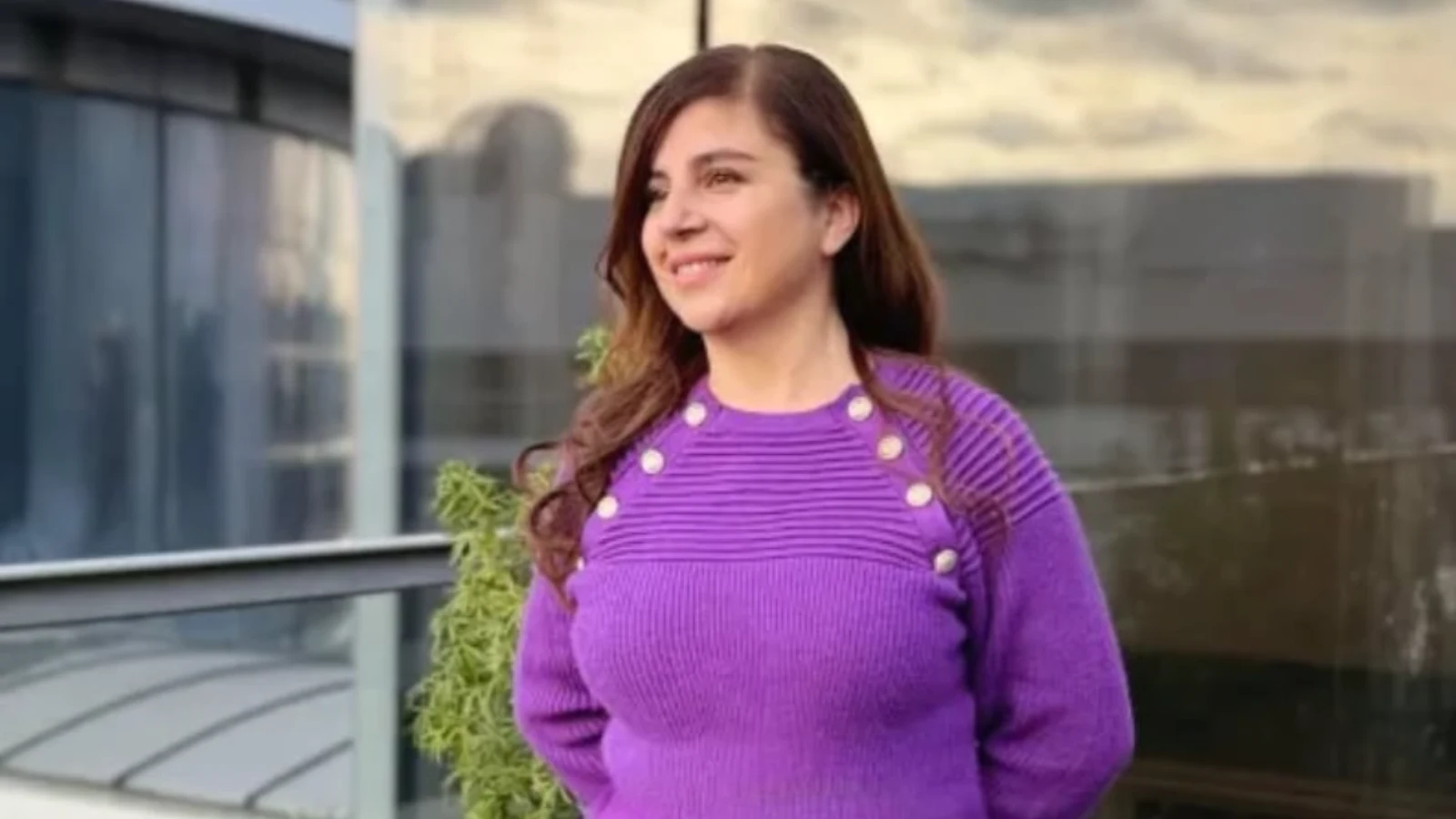
Syrian actress Sulafa Abdullah Oweishiq has rarely appeared in an extended press interview throughout her career. As she said in a side conversation before this interview began, she “loves acting, does not like interviews, and does not care about social media.” She prefers her presence to be defined by what she does in front of the camera, not by what she says outside it.
Today, in the period after the fall of the Assad regime, she chooses for the first time to tell her story: from school theater to the Higher Institute of Dramatic Arts in Damascus, then the years of exile in France with her husband, actor Fares Helou, and finally her current return to film two new productions between Damascus and Beirut.
Oweishiq, born in Damascus in 1969, studied at the Higher Institute of Dramatic Arts while also studying English literature. She is married to Fares Helou, and they have two daughters, Noura and Marah. Her early screen presence began while she was still a student, through the 1985 series Ordinary Sorrows, directed by Amal Hanna.
She later appeared in works that became part of Syrian television memory, including A Five-Star Family and Apricot Girls. In the 2000s, her roles expanded, most notably in Homey Hon, where she played “Al-Sitt Jacqueline,” as well as Ghazlan in the Forest of Wolves, Abu Khalil al-Qabbani, Forbidden Bread, Al-Dabour, Tali al-Fidda and Bab al-Hara. She also wrote for the films Return to Life, Difficult Memory and the quartet Bayt Amer.
As repression escalated in the first years of the Syrian uprising, she left with her family for France because of her husband's public support for the revolution, which made the family's remaining in Syria a direct risk.
From School Theater to the Institute
In her conversation with Al-Modon, Oweishiq described her entrance into art as a natural path that moved from school theater to the institute and then to the screen, without sudden leaps or performative gestures. She said the story began at school, where she constantly participated in writing and acting for school performances, before that early play became an academic and professional choice.
She saw the Higher Institute of Dramatic Arts as the logical extension of that passion, while also needing to reassure her family about a more stable future. For that reason, she studied English literature at the same time. From her first years at the institute, she felt that her presence in the artistic field was “the logical result of an early ambition,” not a coincidence or an adventure.
Work offers came early and did not stop. The challenge, she said, was discovering her own tools inside a profession crowded with names. Her first professional appearance before the camera, in Ordinary Sorrows, allowed her to see herself on screen for the first time, notice her mistakes and learn from them.
Speaking about the unwritten rules that governed entry into the industry at the time, Oweishiq linked opportunity to the production system of the 1980s and 1990s. Directors, producers and decision-makers attended graduation performances at the institute and treated its graduates as a ready reservoir for future projects. Being inside the institute, she said, gave her and many colleagues a kind of prior respect.
But those rules did not remain the same. With the expansion of the market, the arrival of satellite channels and Arab capital, the conditions of visibility changed. Graduation from the institute was no longer sufficient, and sometimes no longer necessary. Personal relations, networks of interest, the new concept of stardom, supply and demand, and the calculations of channels, producers and directors became stronger factors alongside talent.
Exile, Then a Powerful Return
Oweishiq paused at length over the moment of leaving Syria. She described it not as a professional choice or a normal move between markets, but as a forced departure tied to a clear political position. Fares Helou paid the price for standing with the revolution, and the family joined him in France when remaining in Damascus became genuinely dangerous.
They did not expect the absence to last fourteen years. The full weight of that distance appeared only after the first years had passed. At first, the break was painful because it came at the height of her work and her husband's work, but later it became a point of departure toward a different professional space.
After the fall of the Assad regime at the end of 2024, a new stage began. Many Syrians could return, and the discussion about return became different from previous years. Oweishiq links her return to two factors: a political one, related to the disappearance of direct danger, and a professional one, related to receiving offers under conditions she found suitable. Of her return to Damascus, she said: “It gave me my soul back.”
Two Television Projects
This year, Oweishiq is taking part in two drama productions, one filmed in Syria and the other in Lebanon. The first, Bint al-Numan, is a thirty-episode social comedy in which she plays Umm Saeed, a woman from a popular-class Damascene environment. The second is Mawlana, a new drama within the Syrian-Lebanese production season of 2026. She did not reveal details about her role, but said it places her in a new performance space.
Moving between Damascus and Beirut, with Paris still part of her family and professional life, has restored an old feeling of the actor's rhythm. For the first time in many years, she said, she felt again the “beautiful busyness” of moving between two characters, two teams and two different rhythms.
Al-Sitt Jacqueline and the Memory of a Type
When speaking about “Al-Sitt Jacqueline” in the comedy Homey Hon, Oweishiq treated the character as a successful role that gave her wider fame, and as an example of how a television type can be built and continue to live.
The character began in the script. The writers Lubna Haddad and Lubna Mashlah had written it with Oweishiq in mind. The first conversation focused on the features of this woman, her relationship to the Aghabashi household, and her role in carrying news and commentary.
The character's original name was “Al-Sitt Georgette,” but Oweishiq asked to change it because of the meanings it carried. They later agreed on Jacqueline, a name she felt gave the character a distinctive sound closer to the Damascene “auntie” known in neighborhoods. She also worked with the late makeup artist Stella Khalil, mother of actor Maxim Khalil, on shaping the character's exterior look.
Oweishiq does not feel that Jacqueline threatened her image as an actress. She is proud of having played her, and happy that the character remains in viewers' memory, while also feeling she was able to step outside that shadow when different opportunities came later.
Radio as a Space for Continuity
A large part of the conversation focused on her radio work over more than a decade, beginning with Radio Rozana, where she entered the newsroom as a presenter before preparing news bulletins, and later moving to Monte Carlo Doualiya, where she prepared morning programs alongside presenting.
Radio, she said, gave her psychological stability during a time away from acting. It restored essential tools for her as an actress, especially voice, intonation and sentence control, while also giving her daily work that did not depend on a filming season or a broadcast date.
Through those years, she learned how to handle daily news in moments of acceleration, how a bulletin can be rebuilt within minutes, and how priorities shift when new information arrives. That ability to think under pressure later reflected on her work as an actress, both in rhythm and in dealing with text.
France and the Limits of the European Market
Her radio work in France did not prevent her from taking part in drama. She appeared as a guest in the French series Plus belle la vie and Engrenages, and in films including As Far as I Can Walk, which won best film and best actor at the Karlovy Vary festival.
She continued auditioning in France to remain connected to acting and to seek opportunities in the European and international market. But she also regrets the limited number of offers she received. For an Arabic-speaking actress, she said, the main market remains the Middle East, while European opportunities are often limited to specific models within stories of asylum, migration and refugees.
Syrian Drama After Assad
In reading Syrian drama during the years of the revolution and after the fall of the regime, Oweishiq links the matter to production structures more than to individual intentions. Drama, she said, is ultimately tied to capital. Capital determines the permissible topics, the angles of narration and the names placed at the front.
She believes that the Syrian revolution remained marginal and timid in drama, often reduced to humanitarian approaches about family, asylum and division, while avoiding the political origin of the story. What was produced over fourteen years, in her view, does not match the magnitude of the event or the memory that needs to be narrated.
Documentary film, she said, often came closer to fairness than fictional drama because it could enter deeper layers of the Syrian experience and present profiles, violence, displacement and violations with a clarity commercial drama rarely approached.
For the next stage, she ties hope to a high ceiling of freedom of expression and to honest national production tools. Syrians, she said, need local production that has the courage to build the Syrian narrative from within, led by people faithful to memory, able to accept criticism and correction, and able to produce work that respects the difficult Syrian experience of the past years.
No Reward for an Ethical Position
Asked about artists who stood with the Syrian revolution and paid clear prices for their positions, Oweishiq said many of them were marginalized, banned and defamed in previous years, and that their return to drama today is the minimum correction of that injustice.
But she rejects the language of reward. Those who stood with the revolution, she said, did not do so in search of prizes but out of an ethical compass. What matters now is removing the restrictions imposed on them, allowing them to regain their natural place, and leaving time and professional quality to decide who continues.
Why Egyptian Drama Is Ahead
Comparing Syrian and Egyptian drama today, Oweishiq places Egypt's advantage within the structure of the market, not only in artistic value. Egyptian drama has an independent domestic market, advertising revenue and production capacity that allow it to take broader thematic and formal risks.
That financial independence gives it a freedom of movement Syrian drama still lacks. For Syrian drama to recover its regional position, she argues, it needs reform in production and distribution, as well as in language and subject matter.