Nearly three decades after the Venezuelan series Cassandra aired in Syria and Lebanon, the names of its stars, Coraima Torres and Osvaldo Ríos, returned to Arab circulation from Dubai, after their appearance at the third edition of the Humanitarian Leaders Awards.
That appearance reopened the television memory of a generation that grew up in the mid-1990s, when the small screen was the center of the home and the main gate through which foreign images entered daily life for many Syrians.
A Familiar Melodrama
The series arrived from Venezuela with the story of a girl raised in a Roma community, then drawn into a web of love, lineage, money and class. Its plot was close to Arab melodrama's taste for family and emotional conflict, but its visual world was different: looser clothes, long hair, declared passion, and faces from Latin America that felt unusual to local viewers.
In 1996, life in Syria moved within a limited and tightly controlled stability. The state dominated politics, media and the economy; the Baath Party, the security services and emergency law defined the boundaries of public life. The public sector remained broad, basic subsidies were present, and economic opening was partial and limited in its effect on the structure of control.
Socially, the house, school, job, market and evening news shaped a familiar daily rhythm. The internet had not yet entered public life, satellite dishes were rare, and state television controlled the image most people could see.
A Social Appointment
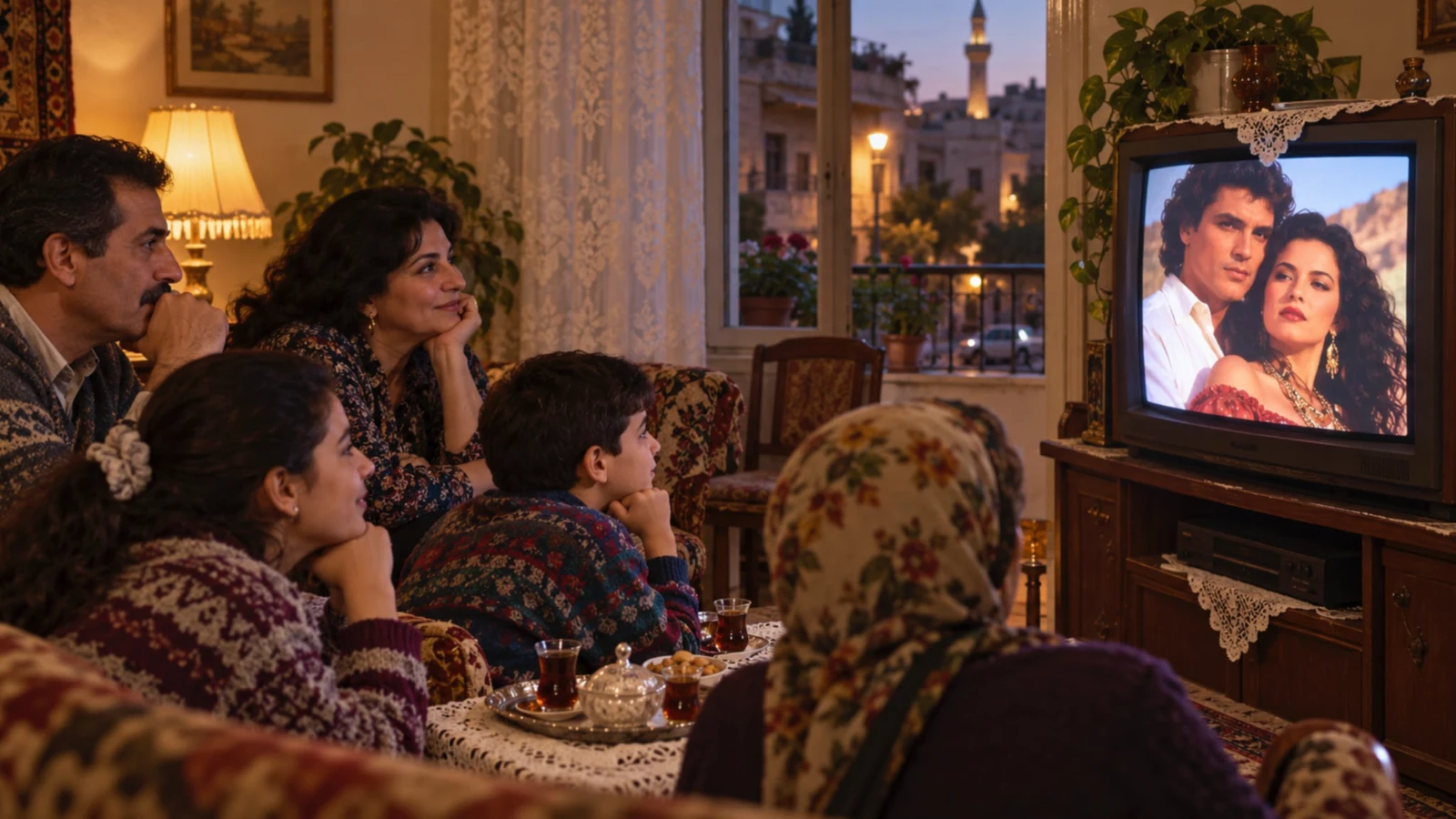
Within this context, programs selected by state television became collective appointments. With Cassandra, the appointment became daily. Some families finished housework before the episode; others postponed visits or outings until after it ended.
If one could return to 1996 at five in the afternoon, many streets would appear unusually empty. From open windows, the sound of the dubbed series would be heard coming from small television sets, with family members gathered around them.
Foreign Culture and Caution
This ritual reveals what television meant at the time. It was a place where families gathered and negotiated taste, censorship, desire and fear of the outside world. Parents, children and sometimes grandparents watched the same work and interpreted it differently: some saw a moving love story, others saw a foreign culture that required caution, and others treated it as a daily pleasure that needed no justification.
Arabic dubbing played a central role in turning the series into part of local memory. The iconic theme song by Lebanese singer Carole Sakr, the classical Arabic dialogue, and the voices of Lebanese performers made the work legible inside the Arab home.
Reopening Memory
After the fall of the Assad family system, the phenomenon of Cassandra is worth revisiting through the politics of Syrian television in the 1990s. How did the Syrian Radio and Television Commission, in a country under severe political and media control, allow a long foreign melodrama filled with love, class, desire and unfamiliar clothing to pass into homes?
One way to read this permission is through the function of entertainment in a state that managed public attention as much as it managed news and political speech. The series offered a distant, pleasurable and still monitored world. It gave people a daily conversation outside politics, while the larger questions remained trapped in official bulletins and state discourse.
Hafez al-Assad and the Management of Inside and Outside
The question gains more meaning when placed in 1996. Around Syria, the region was unsettled: Syrian-Israeli negotiations were moving between talks and failure; Lebanon was living through the effects of Operation Grapes of Wrath and the Qana massacre; the region was under the pressure of the post-Gulf War order and the growing American role.
At the time, Hafez al-Assad managed Syria's political position abroad, while audiences inside the country lived a television day divided between official news that disciplined politics and series that opened other spaces for talk, laughter and desire.
In this sense, entertainment was part of the machinery of control inside a closed system. Cassandra gave people a daily topic away from politics, a fixed emotional appointment, and an external image that could be watched after dubbing and censorship.
Why Venezuela Mattered
The origin of the series may also be part of the answer. Cassandra came from Venezuela, not from the United States or Western Europe. That mattered within an official Syrian discourse that often treated the West as a political and cultural threat to Arab culture. Venezuela was not imagined as an enemy or as a center of American cultural hegemony. It was a distant Latin American country with a large Syrian and Arab diaspora, which made its image politically lighter than direct American production.
The television institution performed a double role: it allowed a foreign dubbed series into homes, then subjected it to the conditions of family viewing. Many viewers remember that more intense romantic scenes were cut or softened, making the work suitable, by the standards of state television, for domestic viewing.
From Screen to Market
The influence of Cassandra moved into markets, clothing and accessories. Skirts, jewelry and hairstyles inspired by the protagonist appeared. A girl could ask in the market for a skirt like Cassandra's, earrings resembling hers, or a hairstyle close to her image. The television image became a commodity that could be sold and locally imitated.
The series' impact is visible in the famous Syrian series The Four Seasons, especially in the episode “Who Doesn't Love Cassandra?” There, the Venezuelan series became a mirror for the Syrian family's relationship with television and foreign culture.
The character Najib, played by Bassam Kousa, presents himself as culturally aware and morally protective of the family. He sees Western culture as a danger, treats the series as proof of that danger, yet continues to watch it while defensively saying that he wants to see “where this nonsense is going.” The phrase captures a wider social paradox: attraction hiding behind the language of protection.
A Doorway to Dubbed Content
From here, Cassandra can be read as an early stage in the Arab reception of dubbed drama, before the later wave of Turkish series such as Noor and Lost Years. In both cases, audiences followed long love stories built around family, class, waiting, jealousy and misunderstanding.
Cassandra helped prepare the idea that a dubbed series could enter the Arab home, create a collective appointment, and move markets, language and imagination. The renewed appearance of its star opens a wider question about pop culture in the Arab world, and in Syria in particular: pop culture did not arrive only from the United States. It also came through Latin American telenovelas, Turkish drama, Lebanese and Egyptian music videos, and later Korean and Japanese culture through the internet.